
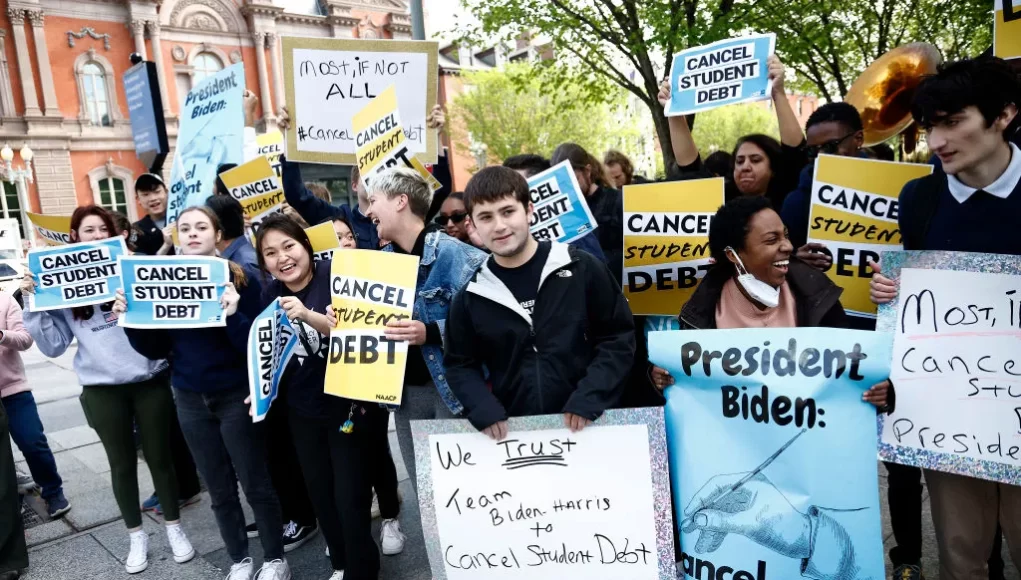
The US Supreme Court has struck down US President Joe Biden’s plan to wipe out billions in student debt.
The 6-3 ruling effectively cancels the plan, meant to forgive about $10,000 (£7,800) per borrower – and up to $20,000 in some cases.
But the plan has been in limbo since some conservative states sued, arguing the president overstepped his authority. The Supreme Court agreed.
The decision affects the loans of more than 40 million Americans.
In the wake of the decision, US media reported that President Biden is expected to announce new actions to protect borrowers later on Friday. In a statement, Mr Biden said that “the fight is not over” and that he believed that the ruling was “wrong”.
The total federal student debt has more than tripled over the past 15 years, rising from about $500bn in 2007 to $1.6tn today.
Last year, the US Treasury took a $430bn charge to cover $300m in costs associated with the loan forgiveness programme, as well as additional costs associated with an extension of a Covid-era moratorium on payments through the end of the year.
The Biden administration faced plaintiffs in two separate cases, one involving six Republican-led states – Nebraska, Missouri, Arkansas, Iowa, Kansas and South Carolina – and the other involving two individual student loan borrowers.
In both cases, plaintiffs argued the executive branch did not have the power to so broadly cancel student debt.
The Supreme Court ruled the two individual borrowers did not persuasively argue they would be harmed by the loan forgiveness plan, effectively ruling that they had no legal standing to challenge the Biden administration’s proposal.
During arguments in February, the Biden administration said that under a 2003 law known as the Higher Education Relief Opportunities for Students Act, or Heroes Act, it had the power to “waive or modify” loan provisions to protect borrowers affected by “a war or other military operation or national emergency”.
In its ruling, the Supreme Court ruled that while the act allows Mr Biden’s education secretary, Miguel Cardona, to “make modest adjustments and additions to existing provisions, not transform them”.
Justice John Roberts wrote that the modifications made by the Biden administration “created a novel and fundamentally different” loan forgiveness programme that “expanded forgiveness to nearly every borrower” in the US.
He added that the administration’s use of the Heroes Act “does not remotely resemble how it has been used on prior occasions”.
The high court’s ruling fell along ideological lines, with its three liberal judges dissenting.
In her dissent, Justice Elena Kagan wrote that “the result here is that the court substitutes itself for Congress and the Executive Branch in making national policy about student-loan forgiveness”.
“Congress authorised the forgiveness plan… the [education secretary] put it in place; and the president would have been accountable for its success or failure,” she wrote.
“But this court today decides that some 40 million Americans will not receive the benefits of the plan (so says the court) that assistance is too ‘significant’”.
The White House had previously estimated that almost 90% of US student borrowers would have qualified for relief under the plan.
BBC