
May 20, 2024
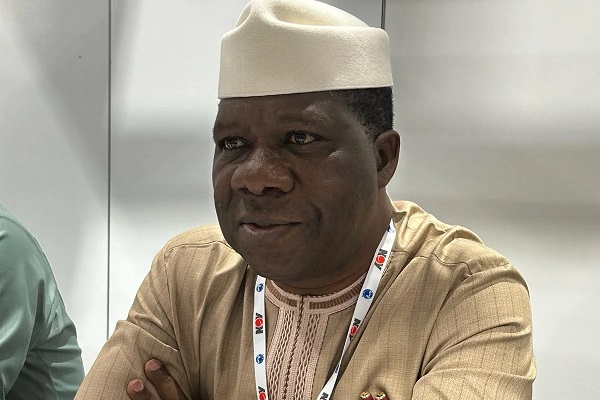
The Senate Leader, Sen. Opeyemi Bamidele, on Monday said establishing state police would deepen internal security if approved.
Bamidele said this in a statement released by the Directorate of Media and Publicity, Office of the Senate Leader, in Abuja.
He said with the present police system, which was “ailing and dysfunctional,” there was the need for state police.
“We must admit that the system can no longer guarantee the dignity of human lives and the security of collective assets considering our security dynamics in the Fourth Republic.
“The proposal for the creation of state police has been a subject of intense debate in the last decade or more.
“This, in part, can be attributed to the rise of armed attacks orchestrated by diverse interests either pursuing divisive agenda or seeking predatory ends in virtually all geo-political zones,” Bamidele said.
The Senate leader noted that Nigeria, as one of the world’s fastest growing nations in terms of population, could not continue operating a unitary security architecture in spite of its strong federal tendencies.
“Such a policing model cannot meaningfully address existential threats to our internal cohesion and stability.
“Unlike in 1979 when we had a population of 70.75 million, Nigeria is now a federation of about 229 million people, currently the world’s sixth biggest country.
“This is as shown in the demographic data of the United Nations. Contrarily, as revealed in the recent presentation of the Inspector-General of Police, Mr Kayode Egbetokun, Nigeria has a police-citizen ratio of one to 650.
“This ratio is a far cry from a ratio of one to 460, which according to the United Nations, is a minimum requirement for every sovereign state or territory worldwide,” said Bamidele.
He added that the shortfall further reinforced the dysfunctionality of the centrally-controlled model the country was currently operating.
According to Bamidele, the on-going review of the 1999 Constitution would avail stakeholders the opportunity to redefine governance structure and recalibrate the security architecture.
“But we must go about it with a clear sense of self-realisation. We must, first and foremost, realise that the present police system is ailing and dysfunctional.
“We must also admit that the system can no longer guarantee the dignity of human lives and the security of collective assets.
“With this admission, it is evident that the option of adopting state police is no doubt inevitable as an antidote to diverse security challenges that threaten us as a federation,” he said.
The senate leader further said as the debate for a more efficient police model persisted, the National Assembly was under obligation to provide a legal framework that provided clearly defined preconditions.
“Sub-national governments must conform with the preconditions before they can establish their own police formation.
“The role of all 36 State Houses of Assembly is equally indispensable in the quest to adopt the decentralised police system,” he said.
NAN