

Every October 1, Nigeria remembers the lowering of one flag and the raising of another. We remember the photographs, the speeches, the ceremony and the optimism of a young nation stepping into the world with the confidence that its future was finally its own. We remember Sir Abubakar Tafawa Balewa standing before the nation and declaring that Nigeria was now an independent country. We remember the celebrations, the music, the excitement and the enormous expectation surrounding that historic moment. But perhaps, after 66 years, the more important question is not what happened on October 1, 1960. We already know what happened. The more difficult question is what we have done with what was handed to us.
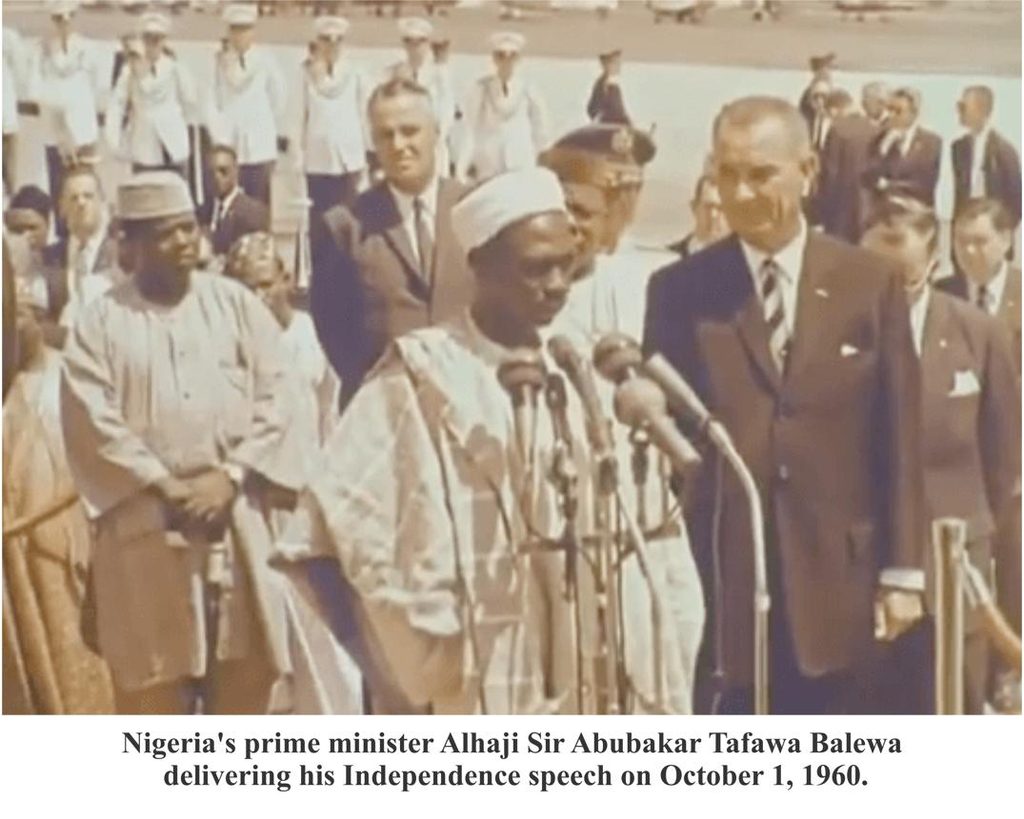
Independence was supposed to transfer political responsibility from a colonial authority to Nigerians. It was never supposed to be the end of the national project. It was supposed to be its beginning. The flag was only a symbol. The real independence was meant to be found in the ability of a people to determine their own economic direction, develop their institutions, educate their children, protect their communities, preserve their cultures and create a society in which the ordinary citizen could live with dignity. Sixty-six years later, Nigeria has achieved some remarkable things. It has survived crises that could have destroyed it. It has produced extraordinary people in science, medicine, literature, business, academia, sports, entertainment and technology. Nigerians have built companies that operate across continents. Nigerian writers have shaped global literature. Nigerian musicians have transformed international popular culture. Nigerian professionals occupy important positions around the world. From Lagos to Ibadan, Kano to Enugu, Aba to Kaduna, ordinary Nigerians continue to demonstrate an extraordinary capacity to survive, adapt and create. And yet, beneath all of this achievement sits an uncomfortable contradiction: we are a country of enormous human capacity that has repeatedly struggled to convert that capacity into institutional strength.
This is perhaps one of the saddest aspects of the Nigerian story. The problem has never been that Nigerians lack intelligence. It has never been that we lack ambition. It has never been that we lack resources. It has never even been that we lack examples of what is possible. The problem is that too many of our successes have remained individual when they should have become institutional. A brilliant Nigerian succeeds abroad, and we celebrate the individual. A Nigerian entrepreneur builds a successful company, and we celebrate the entrepreneur. A Nigerian scientist makes an important discovery, and we celebrate the scientist. A Nigerian artist conquers the world, and we celebrate the artist. But what happens to the institutions that should make thousands more like them possible? That is where the deeper tragedy lies.
The Nigeria of 1960 inherited institutions, imperfect as they were, that could still be imagined as foundations upon which something greater would be built. The generation of independence understood that education was not merely about producing graduates. It was about producing citizens capable of building a society. They understood that infrastructure was not simply concrete and asphalt. It was the physical foundation of economic activity. They understood that regional development mattered because people were more likely to build when they had responsibility for their own environment. The history of the old Western Region is particularly instructive for the Yoruba people. The region did not become influential because its people possessed some magical quality that others lacked. It invested in human capital and institutions. It expanded education. It developed broadcasting. It supported agriculture. It built infrastructure. It created structures that allowed a generation to imagine possibilities beyond subsistence. That history should not become an excuse for romanticising the past. The old Western Region had its own limitations, contradictions and political conflicts. But it demonstrated something that remains important today: development becomes more sustainable when people have institutions close enough to them to demand accountability from those responsible for their progress.
That lesson has become increasingly important as Nigeria continues to debate the nature of its federation. For decades, Nigerians have argued over restructuring, devolution of powers, resource control, state police, fiscal federalism and the proper relationship between Abuja and the federating units. These debates are sometimes reduced to ethnic suspicion or political calculations, but beneath them is a fundamental question about responsibility. Who should have the power to build? Who should have the resources to develop? Who should be accountable when development fails? And perhaps most importantly, should a country as large and diverse as Nigeria continue to concentrate so much political and economic responsibility at the centre? These are not questions that should frighten us. They are questions that a mature federation should be capable of debating honestly. A federation becomes stronger when its component parts have the room and responsibility to develop their own productive capacities while contributing meaningfully to the wider national project.
For the Yoruba people, this conversation carries an additional historical dimension. Yoruba identity existed before Nigeria. Yoruba civilisation existed before Nigeria. Yoruba intellectual traditions, political institutions, commercial networks, cities, kingdoms, literature and systems of knowledge existed before the Nigerian state. Nigeria did not create the Yoruba people. But Nigeria has become part of the modern history of the Yoruba people, just as the Yoruba people have become part of the history of Nigeria. The challenge, therefore, is not to choose between cultural identity and national citizenship as though one must automatically destroy the other. The challenge is to build a Nigeria in which people can retain confidence in who they are while participating meaningfully in a common political and economic project. Cultural confidence does not have to mean hostility towards others, just as national citizenship should not require people to erase the histories and identities that existed before the Nigerian state.
A people who do not know their history will eventually inherit someone else’s interpretation of their past. A people who abandon their language will eventually struggle to transmit certain parts of their intellectual inheritance. A people who destroy their historic buildings in the name of development may discover too late that economic growth without memory produces cities that become indistinguishable from one another. A people who allow traditional industries to disappear without creating modern versions of them may find themselves importing what their ancestors once produced. This is why the question of Yoruba development cannot be reduced to politics. It is also about language, education, architecture, agriculture, technology, publishing, manufacturing, the ownership of businesses and productive assets, and whether our cities are designed merely for consumption or also for production. It is about whether young Yoruba people are being prepared to inherit a functioning economic ecosystem or merely encouraged to search for opportunities elsewhere.
And this brings us to perhaps the most painful question of all: what exactly are we leaving behind? Every generation eventually becomes the ancestor of another. The people who celebrated independence in 1960 are now largely gone. Many of the men and women who witnessed that historic night exist today only in photographs, books, recordings and the memories of those who knew them. They had their moment. Now it is ours. And one day, it will belong to those coming after us. When that day comes, what will they say we did? Will they say we inherited a country full of possibilities and spent our time fighting over access to political power? Will they say we possessed extraordinary natural resources but failed to build the industries required to process them? Will they say we had some of Africa’s brightest young people but created an environment in which too many had to leave before they could fulfil their potential? Will they say we inherited beautiful cities and historical landmarks but demolished them without understanding what we were destroying? Or will they say that our generation finally understood that nation-building is not something governments do for citizens, but something societies build through institutions, discipline, knowledge, investment and collective responsibility?
That is the reflection Independence Day should provoke. Not simply whether Nigeria is better than it was in 1960. Not simply whether one government has performed better than another. Not simply whether the economy is growing or shrinking. But whether we have become better custodians of the country we inherited. There is a tendency to speak about Nigeria as though the country belongs permanently to politicians. It does not. Nigeria belongs to the teacher who wakes up before dawn to teach children. It belongs to the farmer who cultivates the land. It belongs to the mechanic repairing a vehicle on a roadside. It belongs to the entrepreneur employing people. It belongs to the nurse working a difficult shift. It belongs to the journalist documenting events. It belongs to the student studying under difficult circumstances. It belongs to the young person trying to build a future in a country that sometimes makes that future unnecessarily difficult. And it belongs to the generations that have not yet been born.
This is why patriotism should be more demanding than celebration. A country should not ask its citizens merely to love it. It should ask them to improve it. And citizens should not merely ask what Nigeria can give them. They should also ask what they are building that Nigeria can inherit. For the Yoruba, that responsibility is especially important because our history gives us both a heritage to protect and a standard to live up to. We cannot continuously invoke the achievements of previous generations while refusing to build institutions worthy of the next generation. Our ancestors built cities. They established kingdoms. They developed commercial networks. They created systems of governance. They produced art, philosophy, literature and architecture. They traded across regions. They adapted to changing circumstances. They survived wars, migrations, political upheavals and enormous social transformations. Our generation has inherited their name. The question is whether we will inherit their seriousness.
There is no need to pretend that the past was perfect. It was not. There is no need to imagine that everything old must be preserved simply because it is old. It should not. The responsibility of every generation is to decide what must be carried forward, what must be transformed and what must be abandoned. But that decision must be conscious. We cannot allow history to disappear simply because nobody considered it important enough to protect. We cannot allow our economic future to be determined entirely by others because we failed to organise our own productive capacity. We cannot allow our political institutions to remain permanently dependent on the assumption that Abuja must solve every problem. And we cannot continue confusing political participation with development.
Winning elections is not development. Appointing people is not development. Holding political office is not development. Development is what remains after the politician leaves. It is the school that continues to function. The road that remains useful. The hospital that continues to save lives. The factory that continues to employ people. The business that survives its founder. The institution that outlives the government that created it. That is the kind of legacy Nigeria desperately needs.
So, as Nigeria marks another Independence Day, perhaps we should resist the temptation to simply ask whether we are proud to be Nigerians. The deeper question is whether we are worthy custodians of what Nigeria represents. And perhaps for the Yoruba, there is another question that must accompany it: What are we building today that a Yoruba child born fifty years from now will look back upon and say, “They thought about us”?
That is the real meaning of independence. Not merely that someone stopped ruling us, but that we learned how to rule ourselves responsibly. Not merely that we inherited a country, but that we became capable of building one. Not merely that we survived another year, but that we left something stronger behind.
Sixty-six years after independence, the work is still unfinished. Perhaps that is not a reason for despair. Perhaps it is an invitation. The country is still here. The people are still here. The ideas are still here. The capacity is still here. And the future, despite everything, is still unwritten.
Happy Independence Day, Nigeria.