
BLOCK BY BLOCK
A weekly column on what Yorubaland’s fastest-growing cities are keeping, losing, and quietly deciding not to save — one street, one landmark, one demolition notice at a time.
By Oladipupo Ahmed
To enter Abeokuta is to encounter a city born from tactical retreat and carved out of sheer granite geology.
When the Egba refugees fled the collapse of the Oyo Empire in 1830, led by Sódẹkẹ́, they did not settle in an open plain. They fortified themselves beneath the massive granite outcroppings of Olumo Rock (“under the protection of the rock”). The geology itself dictated the city’s defensive perimeter, spatial density, and terraced residential compounds.
Abeokuta became more than a fortress—it evolved into 19th-century Yorubaland’s capital of innovation. Here, the first print newspaper in Nigeria (Iwe Ìròhìn fún Àwọn Ẹgba atí Yòrùbá, established by Henry Townsend in 1859) codified standardized written Yoruba. Here, the Ẹgba United Government (EUG) built early autonomous municipal infrastructure. And here, generations of women master-dyers transformed Itoku into the global epicenter of Adirẹ textile production.
Yet today, as Ogun State positions Abeokuta as an industrial overflow corridor for Lagos, the city’s unique material culture is being dismantled. Massive road dualization projects cut through historic family dye-pits; early 20th-century Afro-Brazilian (Àgùdà) mansions are demolished for generic commercial strip malls; and the spatial link between the city’s granite geography and its textile heritage is being severed.
The central dilemma facing Abeokuta today is urgent: Can Ogun State construct modern transport corridors without liquidating the industrial, literary, and architectural identity that made the Egba nation famous?
The Granite Urban Grid: Geology as Defense and Architecture
Unlike Ibadan’s sprawling brown-roof canopy or Ile-Ife’s concentric royal rings, Abeokuta’s spatial logic was shaped directly by its topography.
The early Ẹgba quarters—Ikija, Itoku, Ake, and Iporo—were built tightly into the natural fissures and terraces surrounding Olúmọ Rock. Granite was not merely a backdrop; it served as a primary structural element and natural building material.
Traditional Ẹgba architecture adapted to this rugged terrain through stone-supported mud walls, stepped terraced compounds, and deep verandahs designed to channel cool mountain air.
However, recent infrastructure expansions have treated this unique terrain with heavy-handed uniform engineering. Cut-and-fill road construction routinely blasts away historic stone outcrop foundations, flattening the natural terraced contours of quarters like Ikija and replacing indigenous stonework with generic concrete retaining walls.
The Indigo Courtyards: Erasing an Indigenous Chemical Industry
Nowhere is this spatial erosion more damaging than in the historic textile district of Itoku and the surrounding Adirẹ dye-pits (Ebu Adirẹ).
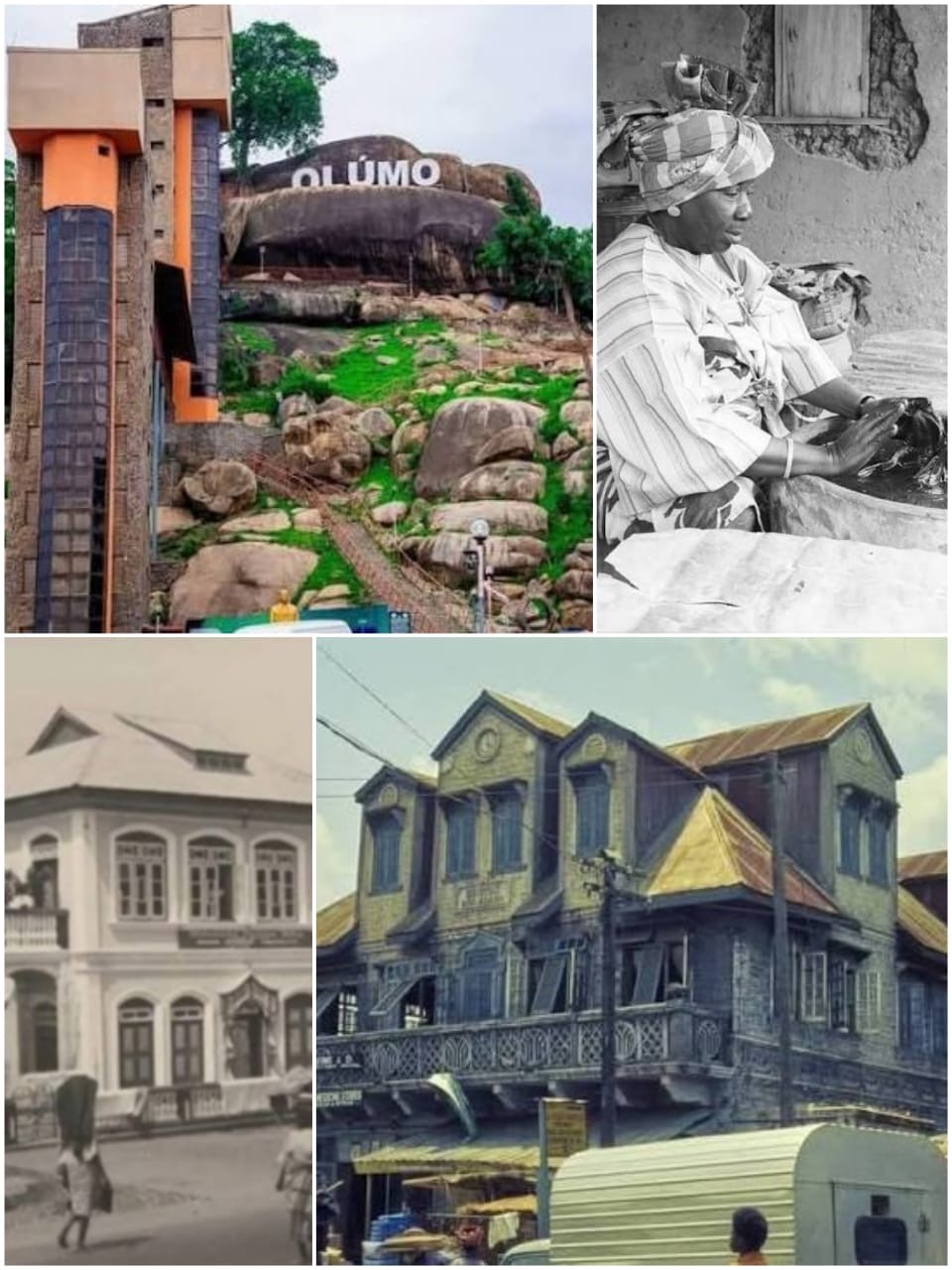
Adirẹ—crafted through resist-dyeing using natural indigo (Elu)—was never just a handicraft. It was a large-scale indigenous chemical and textile industry, managed entirely by female trade guilds. The architectural layout of traditional Ẹgba compounds in Itoku was specifically designed around deep, open-air earthen dye-vats (Amo), built into central courtyards with dedicated drainage and drying racks.
In recent years, modern road widenings and market redevelopments around Itoku have squeezed out these traditional working spaces. Subsurface indigo pits have been filled with concrete rubble, forcing dyers off their ancestral sites or compelling them to switch to synthetic chemical dyes on small plastic tubs along open gutters.
When a city destroys the physical infrastructure of its indigenous industries, it reduces a rich, centuries-old chemical tradition to cheap, imported imitations sold to tourists on the roadside.
Ink, Print, and the Vanishing Afro-Brazilian Mansions
Beyond textile production, Abeokuta was the crucible of Yoruba literary and architectural modernism.
When Henry Townsend set up the press at Ake in 1859 to print Iwe Ìròhìn, he established Abeokuta as the intellectual engine of the region. This literary explosion coincided with the return of emancipated Yoruba artisans from Brazil and Cuba (the Aguda), who brought back sophisticated architectural styles.
Neighborhoods like Ake, Oke-Ijeun, and Itesi became famous for two-storey Afro-Brazilian structures featuring arched windows, ornate stucco plasterwork, carved wooden balustrades, and high ceilings that provided excellent natural ventilation.
Today, these two-storey masterpieces are disappearing at an alarming rate. Lacking municipal protection or adaptive reuse incentives, family heirs often sell historic Aguda properties to commercial developers, who promptly demolish 140-year-old brickwork to construct single-storey concrete lock-up shops or petrol stations.
The Olúmọ Rock Elevator: A Cautionary Tale for Heritage Tourism
Abeokuta’s approach to Olumo Rock itself highlights the perils of poorly executed heritage modernization.
In an effort to turn the rock into a modern tourist site, state authorities installed a multi-storey glass and steel elevator shaft directly against the face of the ancient granite outcropping.
THE OLÚMỌ ROCK INFRASTRUCTURE (OPPORTUNITY/RISK)
- Accessibility for elderly/disabled visitors
- Visual & physical disruption of granite
- Increased tourism revenue potential
- Mechanical breakdown / Disuse
- Modern public amenities
- Disconnect from historic shrines
The result is a striking clash of materials: a heavy glass tower anchored directly into the rock face that provided refuge for an entire nation. Worse, mechanical failures have frequently left the elevator non-functional for long stretches, leaving a stark, rusting industrial frame attached to an ancient natural monument.
This project offers a clear lesson for heritage development: Adding modern amenities to a historic landmark should enhance and respect its natural character, not overshadow it with fragile, high-maintenance structures.
Charting a Heritage Infrastructure Strategy for Abeokuta
Modernizing Ogun State’s infrastructure does not require erasing Abeokuta’s industrial and architectural legacy. Rather, sustainable urban planning can integrate heritage into active economic development.
To protect its unique built environment, state and municipal authorities should implement four key measures:
- Establish an Adirẹ Industrial Protection Zone: The Ogun State Government should designate dedicated, fully serviced Adirẹ craft quarters in Itoku and Ake, equipped with modern eco-friendly drainage, water supply, and protected workspace for indigo dyers.
- Enact an Afro-Brazilian Building Preservation Ordinance: Municipal authorities in Abeokuta North and South must audit and catalog surviving 19th- and early 20th-century Aguda structures, offering property tax credits to families that restore and maintain historic facades.
- Establish the Ake Literary & Print Heritage Trail: The historic printing site at Ake, along with homes of pioneering figures like the Ransome-Kuti family, should be linked into a walk-able heritage corridor with clear historic signage, generating local tourism revenue.
- Implement Context-Sensitive Infrastructure Guidelines: Future road expansion projects in historic quarters like Ikija and Itoku should utilize flexible design standards that preserve natural granite outcrops and historic stone walls instead of defaulting to total demolition.
Block by Block will continue to examine how growth and history intersect across West African cities. Next week, our column moves east toward Ondo and Owo, investigating how timber wealth, royal palace architecture, and modern highway expansion are reshaping the eastern Yoruba frontier.
What historic structure, traditional industry, or natural landmark in your town is currently being threatened by unguided expansion? Share your observations, field photos, and local insights in the comments below.
About the Author
Oladipupo Ahmed is a practicing architect, civic-technology founder, and columnist for The Yoruba Times. He serves as Director and Lead Consultant at Design Craft Construction Ltd and founder of Core Sentinel Data Dynamics. He is the Financial Secretary of the Oyo State Chapter of Think Yoruba First and writes weekly on Yoruba urban history, spatial design, and infrastructure across West Africa.