
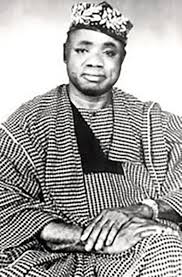
The Man that took Yoruba Literature to Global Stage
Today, 7th December 2023 marks the diamond jubilee celebration for the Yorùbá world, its patrimony and progenies when lovers of Yorùbá literature shall be celebrating the 60th anniversary of the passing unto eternal glory of Chief Daniel Ọlọ́runfẹ́mi Fágúnwà, who until his death was a sage and icon of Yorùbá literature.
You will all agree with me that 60 years is long time, but a short time in the life of a man. It has just rolled by like it was yesterday and today I roll back the stone that guarded the tombstone of a great man and remove his shroud with a eulogy that unmasks the greatness of this man who dominated his literary space like an ogre devouring creativity at its highest in his mother tongue. He was born Oroowole Jaaniini. His father was Fagunwa, the son of Beyiioku from Agbo Ile Asunganga, Okeigbo. Oroowole was baptized as Daniel and adopted the name Olorunfemi when he went to St Andrews Teacher Training College Oyo. There he distinguished himself in music and literature. The Maharishi spoke with his pen like a Pentecostal speaking in tongues at a revival and overwhelmed his readers with his language that weaned you out like a new child sucking his mother’s breast. We never had enough of him and indeed the Yorùbá literary world will never have enough of this man who was always speaking to all like an evangelist who trained with the rabbi at the altar call of morals.
DO Fágúnwà was a Yorùbá property and an image of Yorùbá folklore as well as an epitome of its cultural sagacity. He was the first person to write a complete story in the Yorùbá language and until date his writings continue to inspire Yorùbá culture and legacy. He lived most of his later life at Ibadan, the centre of the Yorùbá world and the Yorùbá political paradise.
D O Fágúnwà was an adult educator, he had a non-formal class with the whole world as his classroom. There he spoke with the audacity of a sage from a larynx that was fecund with sagacity. Fágúnwà took you on a sojourn that was surreal and beyond imagination to a world that was adventurous and loaded with morality. Wole Soyinka evince that he was incorrigibly moral and I add that Fágúnwà ate only the foods of goodness and drank with a goblet of integrity from a pond of purity. His books shall sit well and be held in favor by an Hadith of honour and would be found on hanger-lanes as the Yorùbá Bible of Goodness.
Fágúnwà’s teaching techniques were versatile. He borrowed copiously in his moral curriculum from his Yoruba culture, the Bible, Arabian Folktales and traditions of his birth town Okeigbo engaging in didactics that crisscrossed the boundaries of specificity whilst at the same time homing his thesis to his readers with the temerity of moonlight storyteller. Fagunwa was a philosopher. His theatrics were awesome; his humour overwhelming and his capacity for description was spectacular. Daniel Olorunfemi Fagunwa was audacious with his writings, his jurisprudence was incredible and his understanding of zoology mind boggling. The gentleman regaled in a sagacity that basked on the efficacy of Omoluwabi syndrome.
To Fagunwa, Life was a learning curve. He invited the neighborhood to his classrooms to share with him the wealth of experience of those who have been to the worlds never previously experienced by all. He was normal; his recitations were normal and his language was normal. You needed no new experience to know who Fagunwa was or was talking about. His world was normal though bolstered, flamboyant and flavoured with traditional siftings. His heroes were valiant, hardworking, cultural, gifted and disciplined. Albeit, they were not perfect but erred in their respective lives making mistakes that are not new but evidenced in normal life. These heroes were ogres for personal development and were in sojourns to achieve goodness for their society. In their travails they confronted the unimaginable but triumphed and in groups many fell short of the Golden Fleece because of greed, avarice, overconfidence and envy whilst others were choked by vanity choosing short term gains and futility before grace and triumph.
We Fagunwa’s children celebrate him today, 7th December 2023 with DO Fagunwa Foundation and Department of Linguistics and African Languages, University of Ibadan with a lecture to be delivered in Trenchard Hall by an Ibadan-born iintellectual, Professor Olaide Gbadamosi, a legal marabout and an intellectual whirlwind from the Ifetedo Campus of the Osun State University with an Ibadan collosus and President General of the Central Council of Ibadan Indigenes (CCII), a Chief Barrister Adeniyi Ajewole as the Chairman of the occasion. Chief Ajewole is a Fagunwa scholar and a bastion of traditional jurisprudence. He is proud of his heritage and is Fagunwa inspired. He speaks of Fagunwa with pride like an evangelist quoting the Bible.
Finally, and for the records, I have read a book titled DO Fágúnwà: Beyond the Mythical written by one Mr. Olúwọlé Cole and Mrs Ìbùkúnadé Ṣíjúwọlá (nee Fágúnwà). I need to correct that many of the contents of the book were imagined and belong to their fantasies. I wrote to the authors before the book was launched after I had a look at its content to point out that many of the issues raised were subjects of their imagination. I advised them to add an addendum to the book and correct what I pointed out. They agreed to do these but did nothing to correct any of their flaws. Thus, I need to correct these facts in their Fágúnwà history to check their attempt to rewrite the History of this great man. This is important as in many years to come what is contained in the book would become a historical fact and generations to come including the Fágúnwà descendants would come to believe these incorrect facts about their roots and patrimony. Indeed, these untruths would substitute in two hundred years, Fágúnwà’s legitimate history including that of his descendants especially that one of the authors of the book is DO Fágúnwà’s biological daughter. I have therefore decided to put the Fágúnwà records straight and challenge the authenticity of the claims in the book. I shall cite a few potent of errors for now.
First error is that Béyìíòkú (Daniel Ọlọ́runfẹ́mi Fágúnwà’s grandfather) was from Modákẹ́kẹ́, Ilé-Ifẹ̀. This is far from the truth. Béyìíòkú was an Òwu man from Orílé Òwu in modern Orígbó-Méjèje. He was not from Modákẹ́kẹ́ at all and had no lineage connection. Béyìíòkú’s father was Fáníyì and one of the founders and first settlers of Òkèigbó. Indeed, the only connection DO Fágúnwà had with Modákẹ́kẹ́ was his first wife Mrs Rebecca Fágúnwà and mother of one of the authors who was a native of Modákẹ́kẹ́
A second error in the book is that it claims that Daniel Olọ̀runfẹ́mi Fágúnwà had the facialograph or tribal marks called ‘Abàjà Ọlọ́fà’. These are three vertical marks standing on four horizontal marks. DO Fágúnwà had Abàjà Olówu i.e three vertical marks standing on three horizontal ones and not Abàjà Ọlọ́fà’
The third error is that Joshua Fágúnwà (DO Fágúnwà’s father) was said to owe £4 that DO Fágúnwà had to redeem. DO Fágúnwà when he wrote his first book never paid off any debt. Indeed, Joshua Fágúnwà, Daniel’s father was an affluent man and the landlord of Olójò-o Fágúnwà (Fágúnwà’s farmland) that the writers referred to in the book they published as Oko Olójò. Olójò-o Fágúnwà is a big farmland and exists till today. Further to this, if Joshua Fágúnwà owed £4, it would have been an issue for him in the church where he was the ‘Baálẹ̀ Ìjọ from about 1906 until he died in 1939 (the year Mrs Ìbùkúnadé Ṣíjúwọlá, one of the authors was born). I never came across this information anywhere else except in the book.
Fourth error is that the book claims that DO Fágúnwà died in River Niger. This is not true. DO Fágúnwà died when he drowned in River Wuya, Bida on December 7, 1963. River Niger does not pass through Bida town or anywhere near where DO Fágúnwà died. River Wuya passes through Bida in Niger State; till today, there is a staff in Wuya River on the spot where DO Fágúnwà met his death.
Fifth is that the book says that DO Fágúnwà was a businessman. He was not. DO Fágúnwà was a teacher, civil servant, and administrator.
Sixth error is that Taiwo Kehinde (co-authored with A J Lewis) went as far as Apá Karùn-ń and Apá kẹfà. Their book, Táíwò Kehìndé did not go this far. This Yorùbá grammar textbook is from Apá kìíní to Apá Kẹrìn-n. It is important to mention this so that Fágúnwà researchers in future would not be saddled with the goose chase of looking for a non-existent ‘Apá Karùn-ń and Apá kẹfà
Finally, Kábíyèsí Ikú Bàbá Yèyé, the late Ọba Làmídì Adéyẹmí, the Aláàfin of Ọ̀yọ́ (reigned 1970-2021) was mentioned in the book to have been a pupil of Fagunwa whereas Fagunwa never taught the revered monarch. Kábíyèsí Làmídì Adéyẹmí was born 15th October 1938. This was a few months before DO Fágúnwà left St Andrew’s Practising School in 1939. It would have been impossible for Kábíyèsí Làmídì Adéyẹmí who was less than a year-old boy to have been DO Fágúnwà’s pupil except he was an Àjàntálá.
Many of the contents of the book are untrue but I have only cited these few as a taster to those that may want to cross check the honesty of the book as research material. Indeed, for a book that portends to be writing the truth about DO Fágúnwà, the gamut of errors in it speaks volumes for its integrity. I can only say to all that the book, DO Fágúnwà: Beyond the Mythical should be entertained with care.
By Dipo Fagunwa (Son)
Source: Irohin Oodua