
The Thought Builders Institute
By Oladimeji Bolarinwa
On Thursday, 19 November 2026, in a villa in Shenzhen, three men sat down to talk. Between them, they command the world’s three largest nuclear arsenals, two of its three largest economies and permanent veto power on the United Nations Security Council. Donald Trump of the United States, Xi Jinping of China and Vladimir Putin of Russia had met one another in pairs many times. They had never met as three. Shenzhen changed that.
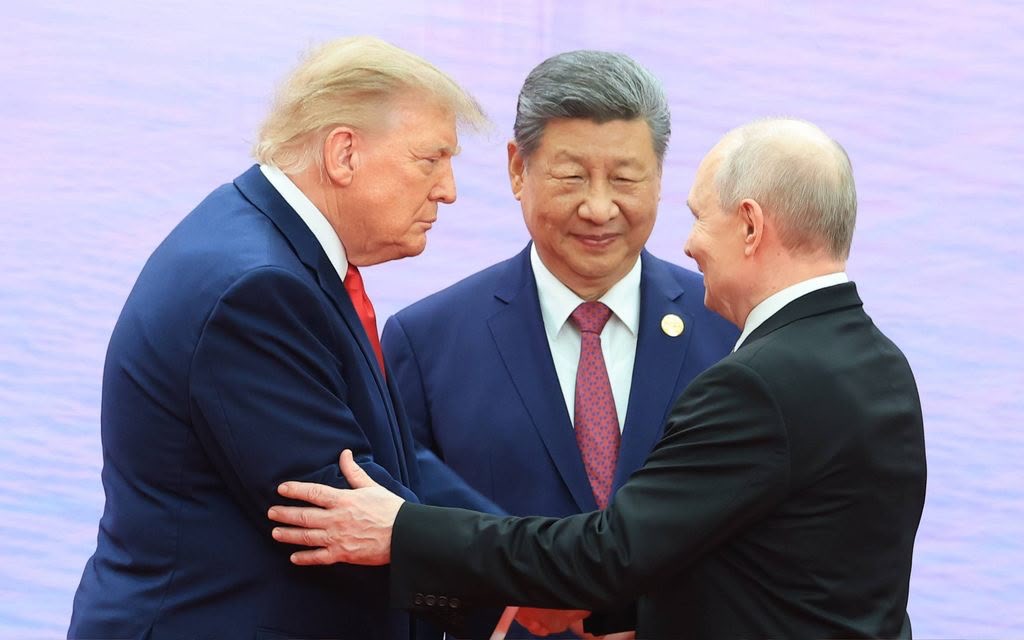
The meeting took place on the sidelines of the Asia-Pacific Economic Cooperation (APEC) summit. It lasted a little over an hour and ended with a joint document the leaders called a “peace declaration.” Trump told the cameras that the three were “making history.” Xi described nuclear weapons as a sword of Damocles hanging over humanity, while Putin said the talks had been very frank.
Strip away the ceremony, and the summit tells us a great deal about how the world is now governed, who is admitted into the room where decisions are made, and who is discussed in their absence. For a people like the Yoruba, who have spent more than a century being discussed in rooms they were never invited into, that lesson matters more than any communiqué.
The joint text, titled the U.S.–Russia–China Heads of State Declaration Toward Peace, contained four broad points. The three leaders pledged to pursue reform of the United Nations, although they provided no details about what such reform would mean or whose interests it would serve. They also promised to increase the production and supply of refined petroleum products “for the benefit of all nations.” On state consent and immunity of officials, the declaration challenged the jurisdiction of the International Criminal Court and similar institutions, warning against what the leaders described as the abuse of their positions. Finally, they committed to dialogue on reducing nuclear dangers and preventing proliferation, while reaffirming that nuclear war must never be fought.
But the omissions speak louder than the text. The declaration made no mention of Russia’s war in Ukraine. It also made no mention of the American war on Iran, which began in February and led Tehran to close the Strait of Hormuz, choking a fifth of the world’s oil trade and sending energy prices soaring. Outside the document, Trump said he and Xi agreed that Iran must not obtain a nuclear weapon and that the Strait of Hormuz must be reopened. But nothing binding followed.
On nuclear arms, the gap between rhetoric and reality is wide. The last US–Russia arms treaty, New START, expired in February. The United States and Russia are each estimated to hold more than 5,000 warheads. China holds just over 600 but is expanding its arsenal rapidly. Beijing has little interest in freezing itself in third place. So there was a promise to talk, but no commitment to cut a single warhead.
The summit was not a peace conference. It was a seating chart for the new world order.
Putin won the photograph. Since 2022, the West has tried to treat him as a pariah, and the International Criminal Court has issued an arrest warrant for him. Sitting as an equal beside the American and Chinese presidents sent a message that efforts to isolate Russia had not removed it from the highest level of global diplomacy. Analysts broadly judged him the biggest beneficiary. Yet even here, there were signals: Xi greeted Trump at the airport but not Putin, a quiet reminder of who occupies the more influential position in the China–Russia relationship.
Xi won the room. He hosted the meeting, sat at the centre and spoke of moving beyond a “Cold War mentality.” China presented itself as an indispensable convener of great-power diplomacy without surrendering anything on nuclear limits, while continuing to strengthen its position in rare earths and critical supply chains.
Trump won a moment. After a difficult period at home, including heavy midterm losses for his party, the summit gave him a place in the history books. But the substance he wanted most, a nuclear arms deal and assistance on Iran, did not materialise.
The absent lost. Ukraine was discussed but not present. Iran was discussed but not present. Europe held a counter-gathering in Berlin. America’s Asian allies watched Washington sit with its two principal rivals and drew their own conclusions. And Africa, home to 1.5 billion people, was not even a footnote.
History has seen this before. In 1815, after Napoleon, Europe’s great powers formed the Concert of Europe and managed the continent among themselves. In 1884–85, at the Berlin Conference, European powers divided Africa without a single African present. In 1945, at Yalta, three men helped shape the post-war map of Europe. Each time, the powerful talked among themselves, while the weak learned their fate afterwards.
Shenzhen did not carve up the world. Experts who warned of a “Yalta 2.0” were too dramatic. But it revealed the direction of travel: a world in which three powers manage major questions among themselves, while international institutions such as the United Nations and the International Criminal Court are bent or bypassed when they inconvenience the powerful.
Consider the ICC clause. Washington, Moscow and Beijing agree on almost nothing, yet they found common ground in warning that international courts should not judge their officials through what they describe as jurisdictional abuse. International law, it appears, remains a rulebook whose enforcement is heavily influenced by those with the greatest power.
Consider the United Nations reform pledge. Africa has no permanent seat on the Security Council. A reform designed by three permanent members during a meeting in which no African representative was present should not automatically be expected to correct that imbalance.
There are eight important lessons the Yoruba nation must draw from Shenzhen. The first is that power is the ticket to the table. Three men were invited to Shenzhen because each possesses the capacity to do great harm or great good to the others. Nobody gets invited simply for being right, ancient or aggrieved. The Yoruba have one of Africa’s oldest civilisations, but civilisation without organised power risks becoming a museum exhibit. Our task is to convert identity into capacity: economic, institutional, intellectual and political. If you are not at the table, you are on the menu.
The second lesson is that rivals still talk. These three powers are engaged in proxy wars, trade wars and arms races against one another. Yet they sat together because their survival demands it. Yoruba elites are divided across political parties, faiths and personal ambitions, and too often refuse to speak to one another. If Washington, Moscow and Beijing can find a common table, there is no excuse for Yoruba leaders not to establish their own regular summit around shared interests: security, land, the Southwest’s economy and the nation’s future constitutional arrangement.
The third lesson is that interests must come before sentiment. Trump calls Xi and Putin his friends, while his country arms Ukraine and fights a trade war with China. Friendship in geopolitics is a tone of voice, not a policy. The Yoruba must judge allies, whether in Abuja, among other ethnic nations or abroad, by what they do for Yoruba interests, not by speeches, religious ties or political party labels.
The fourth lesson is that institutions serve those who build them. The ICC clause demonstrates that global institutions face challenges when their decisions threaten the interests of powerful states. The lesson is not cynicism. It is self-reliance. A people that depends entirely on other people’s courts, media and financial institutions to protect its interests risks abandonment when the priorities of powerful actors change. The Yoruba must build their own institutions: legal defence networks, independent media, research institutes, cooperative finance and lawful security structures.
The fifth lesson is to know your leverage and organise it. China brought rare earths to Shenzhen. Russia brought oil, gas and nuclear weapons. America brought its markets and military power. What does the Yoruba nation bring? More than we realise: Lagos, West Africa’s commercial capital; the Lekki corridor, its ports and refining capacity; a deep pool of professionals and entrepreneurs; a global diaspora stretching from London to Houston to Salvador da Bahia; and a culture industry the world already consumes. Leverage that is not organised is not leverage. It is simply potential that others harvest.
The sixth lesson is that energy is power, and refining is the new prize. The declaration’s pledge on refined petroleum is not an accident. The closure of the Strait of Hormuz has demonstrated that the world is short not only of crude oil but also of refining capacity. The Southwest already hosts Africa’s largest refinery in Lekki. In a world of disrupted energy flows, that is a strategic asset. But under Nigeria’s current constitutional arrangement, the region has limited control over the policies, pricing and revenue structures surrounding such resources. This is the restructuring question viewed through a global lens: the Yoruba cannot fully exploit geopolitical opportunities without the constitutional authority and institutional capacity to act.
The seventh lesson is that image is a weapon. Putin emerged with limited concrete concessions, yet gained from the summit because a single photograph helped challenge years of diplomatic isolation. Perception shapes power. The Yoruba must take control of their own narrative through film, scholarship, journalism and digital media rather than allowing others to define us to the world and to our own children.
The eighth lesson is that multipolarity rewards the organised. A world with three major centres of power is dangerous, but it also creates room to manoeuvre. India, Turkey, Saudi Arabia and the UAE have all expanded their influence by engaging different power blocs without committing themselves entirely to one side. That room is available only to those sufficiently organised and coherent to use it. Disorganised peoples are not courted in a multipolar world. They are competed over.
Shenzhen will be remembered less for what was signed than for who was seated. The new world is being arranged in rooms like that one, among powers that know exactly what they want. Africa was absent. Nigeria was absent. The Yoruba were absent. That is not a reason for despair. It is a call to work.
The Yoruba did not survive the fall of Oyo, the slave ships to Bahia and a century of colonial and post-colonial rule by accident. We survived because we carried our institutions, our language and our sense of self wherever we went.
The task now is to turn that resilience into organised power, so that when the next great summit is held, the Yoruba nation is not merely a subject of discussion, but a party to it.
Ọmọ Oòduà, the world is being redrawn. Let us be among those holding the pen.