
By Adekusibe Ademola
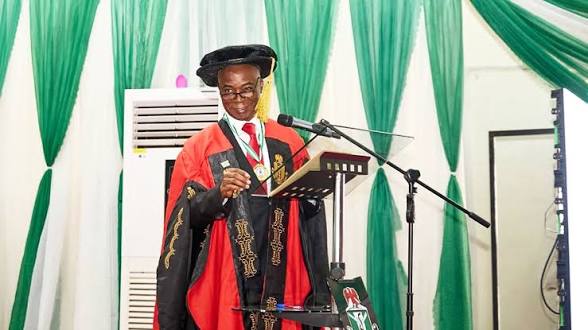
Dr. Tunji Olowolafe has challenged Ekiti State to move beyond its reputation as an education-focused state and begin converting its strong intellectual base into industries, jobs, technology, wealth and measurable improvements in the lives of its people.
Olowolafe, who delivered the lead paper at the Ekiti at 30 Future Summit in Ado-Ekiti on Wednesday, said the next phase of the state’s development must be built around practical application of knowledge, reliable electricity, technical skills, industrial partnerships and access to national and global markets.
Speaking on the theme, “The Path to Ekiti’s Greatness: Opportunities, Choices, and Imperatives for the Next 30 Years,” the medical doctor and corporate practitioner argued that Ekiti already possesses many of the ingredients required for economic transformation, particularly its strong culture of education, human capital and professional expertise.
He, however, said the critical question was no longer whether Ekiti people were educated, but whether the knowledge acquired through education could be transformed into productive enterprises capable of reducing poverty and creating sustainable wealth.
Olowolafe said artificial intelligence, robotics, biotechnology, automation and new energy systems were rapidly changing the global economy, warning that Ekiti must decide whether it would become a participant in the transformation or remain a consumer of technologies developed elsewhere.
According to him, Ekiti’s comparative advantages include its culture of education, merit and ethics, strong tertiary institutions and disciplined workforce. The challenge, he said, was to connect those advantages to practical economic opportunities.
He proposed a ward-by-ward technical audit of Ekiti’s 177 political wards, with the establishment of renewable-energy-powered microgrids capable of providing electricity for schools, health centres, workshops and small businesses.
Olowolafe suggested that solar microgrids in the range of 300 to 500 kilowatts could provide productive electricity for clusters of economic activities in individual wards, arguing that such projects could be developed within the state’s capacity and supported through partnerships with relevant federal agencies.
He also called for a major expansion of vocational education, saying the future economy would increasingly reward practical competence alongside academic qualifications.
He identified areas such as solar installation, welding, fabrication, machinery repair, food processing and other technical trades as skills that could provide young people with direct pathways into employment and entrepreneurship.
Olowolafe noted that Ekiti already has six government technical colleges but argued that their capacity must be expanded and their curricula modernised to meet the needs of hundreds of thousands of young people across the state’s 16 local government areas.
He proposed bringing international vocational-training experts from countries including Switzerland, Germany, Canada and South Africa to help train instructors, strengthen curricula and establish stronger links between technical education and industry.
He also called for greater involvement of major industrial companies in technical education, arguing that industries should participate in curriculum development, provide practical instructors and recruit directly from technical colleges.
For Olowolafe, the ultimate objective is to create a system where technical education leads directly to employment and enterprise, rather than being treated as an inferior alternative to university education.
He cited the growing demand for certified welders, fitters, instrumentation technicians and other technical professionals as evidence of the opportunities available to states that deliberately prepare their young people for industrial work.
Beyond skills, Olowolafe stressed the importance of connecting education, power, enterprise and infrastructure.
He pointed to the Ekiti Knowledge Zone as an example of how young people could potentially build technology businesses from the state while serving clients in major international markets.
He also highlighted the Ekiti Agro-Allied International Cargo Airport as an example of development continuity, noting that successive administrations contributed to the conception, land acquisition, construction and eventual completion of the project.
On road infrastructure, he welcomed the commencement of work on the Ado-Ijan-Ilumoba-Ikole federal road, describing the route as important to the state’s economic and educational development.
Olowolafe also argued that Ekiti’s development must be guided by a stronger culture of empirical inquiry, where traditional knowledge and assumptions are subjected to testing and evidence.
Using a personal childhood experience involving a snakebite, he explained that respect for tradition should not prevent people from seeking the most reliable evidence when health, livelihoods and human lives are at stake.
He linked this philosophy to the work of the Tunji Olowolafe Foundation, which he said had supported the establishment and development of the Gbemisola Olowolafe Memorial Community Secondary School in Are-Ekiti.
The school opened in September 2025 with 100 students and has since grown to more than 170 students, with an ambition to eventually accommodate about 600 students.
An adjoining ICT centre, GOMTECH, provides training in areas including artificial intelligence, coding, graphic design and Mandarin.
Olowolafe also highlighted initiatives at Ekiti State University, where he serves as Chancellor, including efforts to improve digital teaching capacity among lecturers, the development of a financial-markets Trading Room and the installation of high-speed Starlink internet at 12 locations across the university.
He said the broader objective was to ensure that students leave the university with practical, digital and industry-ready skills rather than academic certificates alone.
Agriculture was another major area of concern in his presentation.
Olowolafe recalled seeing cocoa farmers drying cocoa beans by roadsides during his childhood and questioned why Ekiti, with its universities, engineers, scientists and technical professionals, had not developed affordable solar-powered cocoa dryers for farming communities.
He argued that Ekiti should move beyond exporting raw agricultural products and develop systems that allow more value to be captured within the state.
Using cocoa as an example, he called for a deliberate effort to ensure that cocoa produced in Ekiti could be processed into chocolate within the state.
He also identified solid minerals as another area where Ekiti could create greater economic value by developing local capacity for geological research, mineral identification and processing.
Olowolafe said his foundation was collaborating with Ekiti State University to modernise the university’s Department of Geology through improved power supply, internet connectivity, computing equipment and field-testing facilities.
He said the ambition was to develop the department into a leading geology faculty in Africa within five years while also creating vocational training pathways for geological technicians and mine-safety officers.
At the heart of Olowolafe’s presentation was a call for Ekiti to set a more ambitious development timetable.
Although the state’s 30-year anniversary provides a framework for thinking about the next three decades, he argued that many of the proposed transformations should be achievable within 10 years if there is sufficient focus, discipline and continuity.
He proposed that Ekiti stakeholders should meet every two years to assess progress against agreed development targets and hold themselves accountable for areas where implementation falls short.
He further announced three commitments by the Tunji Olowolafe Foundation.
The foundation plans to work with the Ekiti State Government to install or upgrade modern ICT centres in the state’s six government technical colleges, with the centres powered by solar energy and connected to high-speed internet.
It also plans to recruit international vocational-training experts to support teachers, train students and assist with curriculum reform, with success measured by the number of graduates who become certified, employed or establish businesses.
The third commitment is to support the transformation of the EKSU Department of Geology through partnerships with leading mining institutions in Canada and South Africa, while developing vocational certificate programmes for geological technicians and mine-safety officers.
Olowolafe’s proposals formed part of a broader conversation at the Ekiti at 30 Future Summit, where Governor Biodun Oyebanji also unveiled a 30-year vision for the state and identified technology, culture, tourism, innovation and the knowledge economy as key drivers of Ekiti’s future development.
The governor similarly challenged Ekiti’s young people to move beyond acquiring certificates and focus on developing solutions, businesses and innovations capable of creating jobs and improving the state’s economy.
For Olowolafe, the next chapter of Ekiti’s history must therefore be measured not simply by the number of educated people the state produces, but by what those people are able to build.
His central argument was that Ekiti has already demonstrated that it can produce knowledge. The challenge for the next phase is to turn that knowledge into power, skills, industries, businesses, technology, agricultural value chains and wealth.
As he put it in his closing message, the first 30 years proved that Ekiti could exist. The next phase, he argued, must prove that Ekiti can lead.