
By Ademola Adekusibe
September 25, 2025
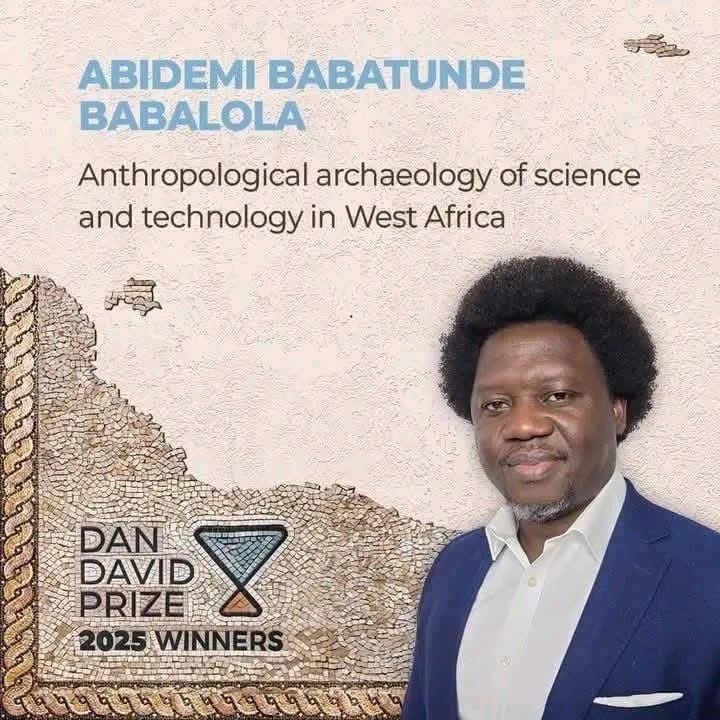
Dr. Abidemi Babatunde Babalola, a Nigerian-born anthropological archaeologist, has been awarded the prestigious 2025 Dan David Prize, one of the world’s largest awards for historical research, in recognition of his groundbreaking work that confirmed the existence of indigenous glassmaking in sub-Saharan Africa.
Babalola, who earned his master’s and doctoral degrees in anthropology and African archaeology from Rice University, will receive $300,000 for his research, which pushes the boundaries of African history and challenges long-held Western assumptions about technological development on the continent.
Through extensive excavations at Igbo Olokun, a site in Ile-Ife, Osun State, Babalola uncovered glass beads, raw materials, and manufacturing debris dating between the 11th and 15th centuries AD. His findings provided the first conclusive evidence that glass production in West Africa was not merely the reworking of imported glass, but rather an independent technological tradition developed locally.
For decades, European scholars argued that sub-Saharan Africa could not have independently mastered glassmaking, often attributing any evidence of glass artifacts to foreign imports. Babalola’s research dismantled this notion, demonstrating that Ile-Ife, regarded as the cradle of Yoruba civilization, was a center of advanced craftsmanship and innovation during the medieval period.
The Dan David Prize committee praised his work for “bringing Africa’s technological past into sharper global focus” and for correcting narratives that overlooked indigenous knowledge systems.
“This award is not just for me but for Africa,” Babalola said in response to the announcement. “It shows that our history is rich with innovation and creativity, and it deserves recognition on the world stage.”
The Dan David Prize, headquartered at Tel Aviv University, Israel, annually honors early- and mid-career scholars who expand the understanding of the past and make history accessible to broader audiences. With prize money of $300,000 per laureate, it is considered the world’s largest history award.
Babalola’s recognition adds to a growing list of Nigerian academics who are reshaping global perceptions of African history, science, and culture. His discovery in Ile-Ife is also expected to inspire further archaeological exploration across the continent, particularly in sites that may hold untapped evidence of Africa’s independent technological achievements.