
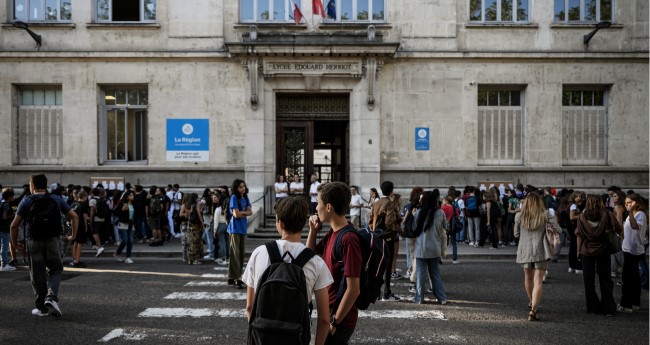
French authorities on Monday imposed a newly announced ban on the abaya Muslim dress for women in schools, with over 500 establishments under scrutiny as children across the country returned to class.
The government announced last month it was banning the abaya in schools, saying it broke the rules on secularism in education that have already seen Muslim headscarves banned on the grounds that they constituted a display of religious affiliation.
The move gladdened the political right, but the hard-left argued it represented an affront to civil liberties.
“Things are going well this morning. There is no incident for the moment, we will continue all day to be vigilant so that the students understand the meaning of this rule,” said Prime Minister Elisabeth Borne as she visited a school in northern France.
But she added that there was a “certain number” of schools where girls had arrived wearing an abaya.
“Some young girls agreed to remove it. For the others, we will have discussions with them, and use educational approaches to explain that there is a law that is being applied,” she added.
The hard-left has accused the government of centrist President Emmanuel Macron of trying with the abaya ban to compete with Marine Le Pen’s far-right National Rally and shifting further to the right.
Education Minister, Gabriel Attal, told RTL radio that authorities had identified 513 schools that could be affected by the ban at the start of the school year.
There are around 45,000 schools in France, with 12 million pupils going back to school on Monday.
Related News
He said work had been done ahead of the start of the school year to see in which schools this could present a problem, adding that trained school inspectors would be placed in certain schools.
Attal, however, said he was against imposing a ban on parents wearing clothes that had religious significance when they accompanied their children on school outings.
“There is a difference between what happens in school and what happens outside school. What matters to me is what happens in school,” he said.
Some leading figures on the right have called on the government to make children wear school uniform in state schools and Attal said he would announce a uniform trial in the autumn.
“I am not sure it’s a miracle solution that will solve all school problems. But I think it merits testing,” he added.
A law introduced in March 2004 banned “the wearing of signs or outfits by which students ostensibly show a religious affiliation” in schools.
This includes large crosses, Jewish kippas and Islamic headscarves.
Unlike headscarves, abayas — a long, baggy garment worn to comply with Islamic beliefs on modest dress — occupied a grey area and had faced no outright ban until now.
AFP