
July 20, 2025
By Ayinde Adeleke
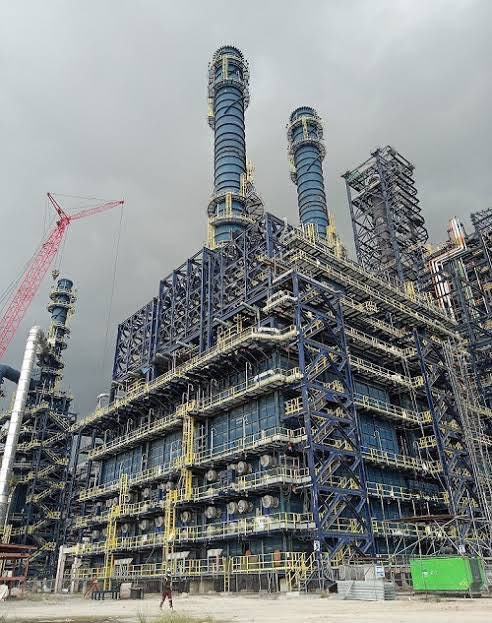
The Dangote Petroleum Refinery in Lagos is undergoing modifications to increase its capacity from 650,000 barrels per day to 700,000 barrels per day.
This upgrade, adding 50,000 barrels per day to the facility’s capacity, is expected to be completed in the fourth quarter of this year. Alhaji Aliko Dangote, President of the Dangote Group, revealed this during a recent tour of the refinery in Lekki, Lagos.
Dangote explained that the largest single-train refinery couldn’t operate at full capacity this year due to ongoing modifications but expressed confidence that these changes would enhance the refinery’s output.
As of July 2025, the Residue Fluid Catalytic Cracking (RFCC) unit is operating at 85 percent capacity. RFCC is a process used to convert heavy residues into lighter, more valuable products like gasoline, LPG, and diesel.
“Our RFCC is at 85 per cent. We are not up to 100 per cent because there are some modifications that we are doing. It will finish by the end of the year, and we believe we will get to 700,000 bpd, not even 650,000, because all the other components that we have and all the other departments have all (reached 100 per cent). Some are even doing up to 145 per cent. So, we’ve done very well in that area,” Dangote said.
Dangote disclosed that the refinery purchased 19 million barrels of crude oil from the United States between June and July.
The U.S. supplies about 55 percent of the refinery’s crude needs. “As a company, we bought 10 million barrels of crude this month. So, 10 million barrels this month means that at the capacity we are, it’s about 55 per cent coming from the US,” he said.
The billionaire recalled deciding to build the $20 billion refinery to achieve energy self-sufficiency for Nigeria and Africa.
He opted to build a new refinery after his attempt to purchase government-owned refineries was halted by late President Umar Yar’Adua in 2007. Dangote noted that building a refinery wasn’t like building a house and expressed confidence that completing the project proved nothing is impossible.
“People believe building a refinery is like building a house, but, like what I keep saying, if I knew what we were going to face, I wouldn’t have started it at all. So, the luck that we’ve had now as a group was because we didn’t know what we were getting into, really, and we believe that nothing is impossible,” he said.
Dangote emphasized that having a refinery in Africa was necessary since many African countries rely on fuel imports.
He also commented on foreign actors impacting industries in sub-Saharan Africa through imports. “If you go to Lome, you will see a massive number of ships. That’s what they do to attack all the industries in sub-Saharan Africa. Even if you look at the refineries in South Africa, they are actually not operating. Only one is now operating in South Africa, but we were able to take this risk,” he added.