
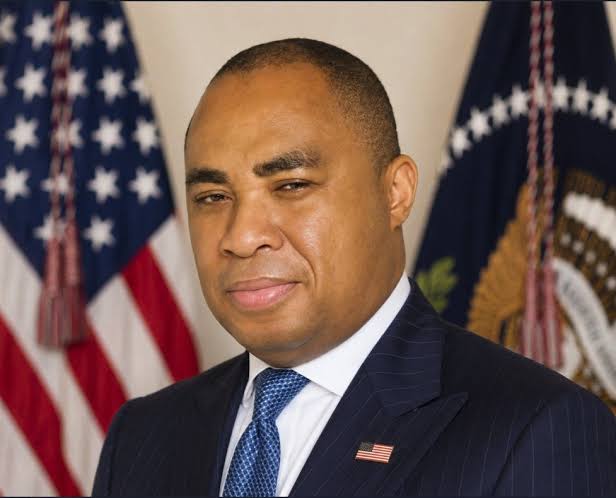
Nigerian-born United States lobbyist Karl Okeke Von Batten, whose firm is reportedly working for former Vice President Atiku Abubakar under a $1.2 million lobbying and reputation-management contract, has been appointed by US President Donald Trump to an unpaid education commission, not a White House policymaking position.
The development followed an announcement by Von Batten on September 3 that President Trump had appointed him as a commissioner on a “White House presidential commission.”
The description immediately attracted attention in Nigeria, particularly because of his connection to Atiku and the reported $1.2 million contract between Atiku and Von Batten’s Washington-based firm.
However, checks have now established that the commission in question is the Commission on Presidential Scholars, an education-focused body administered by the United States Department of Education.
The commission is responsible for reviewing finalists and selecting outstanding graduating high school students for recognition under the US Presidential Scholars Program.
It does not formulate White House policy and has no mandate over US foreign policy, national security, intelligence, diplomacy or US relations with Nigeria.
Trump administration officials cited in the report clarified that Von Batten’s appointment does not make him a White House official and does not give him policymaking authority.
The position is also unpaid. Commissioners serve at the pleasure of the President, receive no salary from the US government and do not require confirmation by the US Senate.
The clarification has therefore raised questions over the way Von Batten initially presented the appointment, particularly his use of the description “White House presidential commission” without identifying the commission, explaining its responsibilities or providing an official appointment letter.
According to the report, no corresponding announcement was immediately found on the White House website when his initial claim was made. Subsequent checks identified the body as the Commission on Presidential Scholars.
The appointment is nonetheless a presidential appointment and carries a degree of prestige. The Commission on Presidential Scholars was established by former US President Lyndon B. Johnson through Executive Order 11155 on May 23, 1964.
The programme recognises exceptional graduating high school students for academic excellence, leadership and service.
As a commissioner, Von Batten will participate in reviewing semifinalists and selecting up to 161 Presidential Scholars annually. Recipients are presented with the Presidential Scholars Medallion, one of the highest federal honours available to graduating high school students. More than 8,000 students have reportedly received the recognition since the programme was established.
The controversy surrounding the appointment is largely connected to Von Batten’s political work in Washington.
His firm, Von Batten-Montague-York, L.C., was reportedly retained by Atiku Abubakar under a 12-month agreement valued at $1.2 million for government-affairs, strategic-advisory and lobbying services in the United States.
That connection has made the description of his new role particularly significant in Nigeria, where any suggestion that an individual has obtained a powerful White House position could carry substantial political implications ahead of the 2027 elections.
However, the available details show that the appointment is fundamentally an education-related role.
It does not give Von Batten executive authority, diplomatic status or a formal mandate to influence American policy towards Nigeria.
It also does not place him in a position to make or determine US government policy concerning President Bola Ahmed Tinubu, Atiku Abubakar or Nigeria’s 2027 presidential election.
The distinction is therefore important: while Von Batten has indeed received a presidential appointment from Trump, describing the position simply as a “White House” appointment without explaining that it is an unpaid education commission risks giving Nigerians a significantly different impression of the actual nature and powers of the role.
The development has consequently shifted attention from the prestige of the appointment to the question of how accurately it was initially presented.