
By Ademola Adekusibe
There is a history of Lagos that some people would rather Nigerians forget. It is the history of how powerful political interests converged in 1953 to separate Lagos from the Western Region, against the position of Chief Obafemi Awolowo and his Action Group. At the centre of that confrontation were two influential political figures: Nnamdi Azikiwe of the National Council of Nigeria and the Cameroons (NCNC) and Ahmadu Bello of the Northern People’s Congress (NPC). They came from different political backgrounds, represented different regional interests and had their own ambitions, but they found common ground in one crucial objective: Lagos must be removed from the Western Region. More than seven decades later, as some contemporary voices continue to question the Yoruba identity of Lagos and describe it as nobody’s land, the Yoruba must revisit that history and ask whether the political thinking behind the old struggle has simply taken a new form.
Lagos was not an empty settlement waiting for Nigeria to give it an identity. It was an established Yoruba city with indigenous communities, traditional institutions, royal history and ancestral landholding families long before colonial administration transformed it into the country’s commercial and political centre. Its strategic location, seaport, growing industries and commercial importance made it one of the most valuable political territories in colonial Nigeria. The question of who would administer Lagos was therefore never merely an administrative disagreement. It was a struggle over political influence, economic power and the future structure of the Nigerian federation.
Chief Obafemi Awolowo and the Action Group understood what was at stake. They wanted Lagos to remain within the Western Region, its historical and administrative relationship with the Yoruba West notwithstanding its position as Nigeria’s capital. Awolowo’s position was that Nigeria could establish a new federal capital in a more central location without removing Lagos from the Western Region. It was a proposal that would preserve the region’s connection to its historic commercial centre while allowing the federal government to establish a separate capital elsewhere.
But Nnamdi Azikiwe was opposed to that arrangement. His NCNC argued that Lagos should not be incorporated into the Western Region and that its representation in the central legislature should be direct. His opponents interpreted his position as an attempt to protect his political influence and business interests in Lagos from the control of a Western House of Assembly dominated by Awolowo’s Action Group. HistoryVille recounts that Azikiwe had been excluded from political leadership in the Western Region in 1952, making the dispute even more politically sensitive.
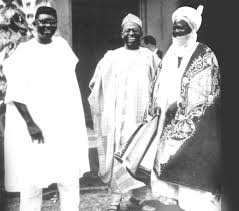
Then came Ahmadu Bello. The Sardauna of Sokoto and leader of the Northern People’s Congress had his own political calculations. Lagos was the country’s principal commercial gateway, and its economic importance made control of the city a matter of national political strategy. The NPC had little interest in allowing Awolowo’s Western Region to retain direct authority over such an important centre of commerce and administration. The political interests of the NCNC and NPC were not identical, but they converged against Awolowo’s position. Azikiwe and Bello were united in their opposition to keeping Lagos within the Western Region.
This was the political alignment that changed the course of Lagos’s constitutional history. At the 1953 London Constitutional Conference, held between July 30 and August 22, the status of Lagos became one of the most contentious issues. Awolowo’s Action Group defended the position that Lagos should remain part of the West, while the opposing political interests favoured its separation as a federal territory. Awolowo even threatened secession if Lagos was removed from the Western Region. The British Colonial Secretary, Oliver Lyttelton, eventually took responsibility for deciding the matter. He announced that Lagos would be separated from the Western Region. The Lyttleton Constitution of 1954 subsequently formalised the arrangement, transferring the city’s legislative, executive and judicial administration from the Western Region to the federal government.
The consequences were enormous. The Yoruba political leadership lost direct constitutional control over Lagos, while the federal government acquired authority over a city that had historically belonged to the Yoruba world. Azikiwe and Bello had achieved the political outcome they had pursued against Awolowo. The constitutional separation did not physically remove Yoruba people from Lagos, nor did it erase their ancestral communities. But it changed the political arrangement governing their historic city. That is why the title of this article speaks of erasing the Yoruba people out of Lagos: it describes the political consequences of removing the city from the regional structure through which Yoruba political authority had been exercised, not a documented agreement to expel its inhabitants.
The question now is what the contemporary generation has learnt from that history. Some of the loudest voices in today’s arguments over Lagos’s identity come from commentators and political actors of Igbo background who insist that Lagos is nobody’s land, or who present the city’s cosmopolitan character as a reason to dismiss its indigenous Yoruba identity. The political descendants of Azikiwe may not all share his positions, and no ethnic group should be treated as a single political organisation. But the Yoruba cannot ignore the similarities between the old constitutional argument and the modern rhetoric that seeks to detach Lagos from its historical identity.
The expression “no man’s land” is particularly provocative because it attempts to turn the presence of different Nigerian communities into an argument against the existence of an indigenous people. It is as though the arrival of migrants, the expansion of commerce and the growth of a city automatically cancel the history of those who were there before. By that reasoning, every successful African city would eventually become ownerless simply because people from different regions and countries have settled there. That is not how history works. A city can be cosmopolitan and still have an indigenous identity. Lagos can welcome every Nigerian without pretending that it had no original inhabitants.
Some contemporary arguments go even further, presenting Igbo commercial success and property acquisition in Lagos as evidence of a growing claim over the city. There is nothing wrong with Igbo entrepreneurs acquiring businesses, buying houses, investing in industries or building wealth in Lagos. Their constitutional rights must be respected, just as those of every Nigerian. But a property transaction does not transfer the ancestral identity of an entire city. Buying a house in Lagos does not make someone the founder of Lagos. Owning a commercial property does not give anyone the authority to declare the indigenous population irrelevant. Economic influence is not ancestral ownership, and commercial success is not a licence to rewrite history.
The Yoruba should be particularly concerned whenever property ownership is turned into an ethnic boast, especially when it is accompanied by suggestions that the original inhabitants can be reduced to tenants or that the city can be claimed through accumulated wealth. Such arguments, where they are made, deserve a direct response. Nobody should be intimidated for buying property in Lagos, regardless of their ethnicity. Equally, nobody should use the right to acquire property as an excuse to insult the history of the host community. The right to own a building is not the right to own the identity of the land on which it stands.
There is a question that those who insist Lagos is nobody’s land must answer. Would they accept the same argument about Enugu, Anambra, Kano or Sokoto? Would the presence of millions of Nigerians from other ethnic backgrounds in those cities erase their indigenous histories? Would the acquisition of properties by Yoruba, Hausa or other Nigerian investors give them the right to declare those cities ownerless? If not, why should Lagos be subjected to a different standard? The Yoruba cannot be expected to celebrate national unity while being told that their historical identity must disappear whenever another group questions it.
The contemporary generation of Igbo public commentators must also understand that challenging historical claims does not require hostility towards other Nigerians. They can defend the rights of Igbo residents in Lagos without denying Yoruba history. They can celebrate Igbo entrepreneurship without presenting it as a political conquest. They can demand equal treatment without insisting that Lagos has no indigenous people. The same responsibility applies to Yoruba politicians and commentators: defending Lagos’s history must never become an excuse to discriminate against peaceful residents from other parts of Nigeria.
But the Yoruba must also look inward. The events of 1953 exposed the consequences of political calculations, weak alliances and the inability to protect regional interests when powerful opponents converged around a common objective. Awolowo’s defeat over Lagos should have taught generations of Yoruba leaders that history and population alone do not guarantee political influence. A people must organise, preserve their institutions, develop their intellectual capacity and defend their legitimate interests through lawful political engagement. It is not enough to remember what happened in 1953 while allowing the same questions of identity, representation and political influence to be treated casually today.
The most troubling part of the present controversy is that some people appear to confuse the generosity of Lagos with an absence of ownership or history. Lagos became a national commercial centre partly because it attracted people from across Nigeria. Its markets, transport networks, industries, educational institutions and opportunities have made it a home for millions. That is something to celebrate. But the Yoruba did not surrender their history by opening their city to Nigerians. Hospitality is not a declaration that the host has no ancestral connection to the land.
The political history of Lagos must therefore be told without apology. In 1953, Azikiwe’s NCNC and Ahmadu Bello’s NPC united against Awolowo’s Action Group over the constitutional status of Lagos. Their political alignment helped secure the separation of the city from the Western Region, a decision that fundamentally changed its administration. Today, some voices are again challenging the Yoruba identity of Lagos, using the language of cosmopolitanism, economic influence and property ownership. These are different circumstances, and the present-day actors are not automatically carrying out the same political project as their predecessors. But the historical parallel deserves serious examination.
The Yoruba must not allow the debate to be reduced to ethnic insults. The issue is history, political representation, cultural identity and the right of indigenous communities to have their heritage recognised. Nigerians from every part of the country should be able to live, work, invest and prosper in Lagos. They should also be able to recognise that the city has an indigenous history that did not begin with their arrival or with the creation of Nigeria.
You can buy land in Lagos through a lawful transaction. You can build a business, acquire properties, employ thousands of people and become one of the city’s most successful investors. You can make Lagos your permanent home. But you cannot purchase the history of its indigenous communities. You cannot acquire another people’s ancestry through a deed of assignment, and you cannot turn a historic Yoruba city into nobody’s land simply because it has become the economic centre of Nigeria.
The battle for Lagos did not end in 1953. Its constitutional chapter changed, but the argument over identity and belonging continues. The Yoruba must remember their history, defend their heritage and reject the idea that welcoming others requires forgetting themselves.