
By Ademola Adekusibe
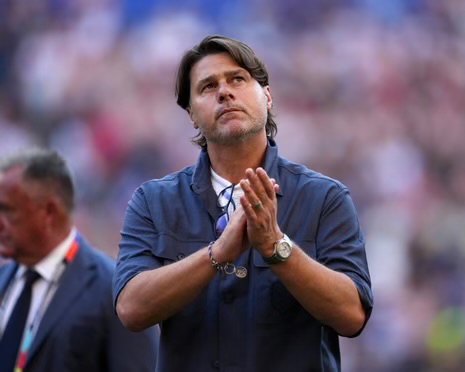
Manchester United are preparing to open another chapter in their managerial history, and this time, the man expected to take responsibility for restoring the club’s identity is Argentine tactician Mauricio Pochettino.
After dismissing Michael Carrick following a disappointing run of results, United have reached an agreement with the former Tottenham Hotspur, Chelsea and Paris Saint-Germain manager to become their next head coach. Pochettino is expected to sign a two-and-a-half-year contract, bringing an end to his spell with the United States men’s national team.
It is a significant appointment for a club that has spent more than a decade searching for the managerial stability and competitive identity it enjoyed under Sir Alex Ferguson.
But the question surrounding Pochettino’s arrival is bigger than his reputation. Can he restore Manchester United’s competitiveness, rebuild confidence within the dressing room and make Old Trafford a difficult place for opponents to visit again?
Why Manchester United Turned to Pochettino
Manchester United’s decision comes at a particularly difficult moment.
The club’s recent performances have fallen considerably below expectations, with the team struggling for consistency and finding itself in the Premier League relegation zone.
Carrick, who initially impressed after taking charge and guided United to a third-place finish in the previous campaign, could not maintain that momentum. A disappointing sequence of results, including just one victory in the league, ultimately cost him his position.
United’s hierarchy subsequently turned to Pochettino, a manager who has been considered for the Old Trafford position on previous occasions.
His name has repeatedly featured in discussions about the United job, particularly because of his experience in English football, his ability to develop young players and his reputation for building competitive teams.
According to reports, United’s leadership believes the current squad possesses considerably more quality than its recent performances suggest. Pochettino’s assignment will therefore involve finding a way to make that potential visible on the pitch.
The Tottenham Experience: A Blueprint for Rebuilding
Perhaps the strongest argument in Pochettino’s favour is what he achieved at Tottenham Hotspur.
When he arrived in 2014, Tottenham were not operating at the same financial level as Manchester City, Chelsea or Manchester United. Yet he gradually constructed a team capable of challenging those clubs.
He developed young players, established a recognisable football philosophy and created a side that became one of the most exciting teams in the Premier League.
Harry Kane, Son Heung-min, Dele Alli and Christian Eriksen were among the players who flourished during his time in North London.
His Tottenham side finished second in the 2016/17 Premier League season and reached the Champions League final in 2019, eventually losing to Liverpool.
Although he did not win a major trophy with Tottenham, his achievements demonstrated his ability to build a competitive team without depending entirely on expensive transfers.
That experience could prove particularly relevant at Manchester United, where recruitment, player development and tactical consistency have all become important issues.
What Pochettino Will Bring to Old Trafford
Pochettino is known for his high-intensity football, aggressive pressing and emphasis on collective responsibility.
He wants his teams to compete for every ball, press opponents high up the pitch and transition quickly from defence to attack.
His football philosophy requires considerable physical commitment, tactical discipline and intelligent movement.
At Manchester United, this could mean a significant change in how the team approaches matches.
United have often struggled to maintain control of games, protect defensive spaces and produce consistent performances. Pochettino will need to address these problems without sacrificing the attacking qualities traditionally associated with the club.
He will also have to establish clear responsibilities among his midfielders, defenders and forwards.
The objective cannot simply be to make United run more. It must be to make them function better as a collective unit.
His Previous Experience at Chelsea and PSG
Pochettino’s managerial journey has not been without disappointment.
At Paris Saint-Germain, he managed some of the biggest names in world football, including Lionel Messi, Neymar and Kylian Mbappé. He won the French Ligue 1 title in the 2021/22 season but failed to deliver the Champions League trophy that the club’s ownership desperately wanted.
His experience at Chelsea was another complicated assignment.
He inherited a young squad during a period of significant restructuring. Although the team struggled with injuries and inconsistency, Chelsea improved towards the end of the 2023/24 campaign, finishing sixth in the Premier League.
These experiences reveal both his strengths and limitations.
Pochettino has demonstrated an ability to organise teams, develop players and establish a footballing identity. However, questions remain about his capacity to convert promising projects into sustained trophy-winning success.
At Manchester United, those questions will follow him from his first day.
The Biggest Challenge: Managing Manchester United
Managing Manchester United is different from managing most other clubs.
The pressure surrounding the position is enormous. Every poor result attracts attention, every tactical decision is examined and every transfer becomes a subject of debate.
Pochettino will inherit a club whose supporters are tired of managerial changes and repeated promises of rebuilding.
He must therefore understand that supporters are not simply looking for another manager with an attractive football philosophy. They want evidence of progress.
His relationship with the club’s hierarchy will also be crucial.
Manchester United have experienced repeated disagreements and structural difficulties during their post-Ferguson years. Managers have arrived with different ideas, but the club has struggled to maintain a consistent footballing direction.
Pochettino cannot be expected to solve every institutional problem alone. The sporting leadership must provide him with a clear recruitment strategy, effective support and sufficient authority to implement his ideas.
Without that cooperation, even an experienced manager could find himself fighting problems beyond the touchline.
A New Opportunity for a Manager Who Has Long Wanted the Job
There is an interesting dimension to this appointment.
Pochettino has previously been linked with Manchester United, but circumstances prevented the move from happening.
Now, following his work with the United States national team, the opportunity has finally arrived.
His international experience also offers an additional perspective. Preparing a national team for major tournaments requires tactical flexibility, efficient use of limited training time and the ability to unite players from different footballing backgrounds.
Those qualities could be useful in managing a dressing room containing players with different personalities, expectations and levels of experience.
However, club football presents a different challenge. Pochettino will have to work with his players daily, prepare for a demanding domestic schedule and build consistency across several competitions.
Can Pochettino Restore Manchester United?
The appointment represents an opportunity, but it is not a guarantee of success.
Manchester United need more than a change in the technical area. They need a clear footballing direction, intelligent recruitment, stronger defensive organisation and a squad capable of executing the manager’s instructions.
Pochettino has demonstrated at Tottenham that he can build a team with a strong identity. His work in Paris and London has also exposed the difficulties of managing clubs where expectations are exceptionally high.
Old Trafford will demand results, but the club must also allow the Argentine to establish a sustainable structure.
For Pochettino, this is arguably one of the most defining assignments of his managerial career. He has the opportunity to manage one of football’s most historic institutions and demonstrate that his philosophy can deliver sustained success at the highest level.
For Manchester United, the appointment is another attempt to move beyond the uncertainty that has characterised the post-Ferguson era.
The real test will not be the excitement surrounding his arrival or the reputation he brings. It will be what happens when the football begins.
At Old Trafford, promises are no longer enough. Manchester United need results, an identity and a team that can make its supporters believe again.