
By Remi Oyeyemi
Language is far more than a utilitarian instrument for communicating everyday thoughts and exchanging information. It is the living breath of a civilisation, the repository of historical consciousness and an enduring bridge connecting the ancestors, the living and generations yet unborn.
Across the vast and diverse linguistic landscape of Africa, the Yoruba language, Èdè Yorùbá, stands as a remarkable expression of intellectual achievement, spiritual depth and cultural sophistication. Spoken across southwestern Nigeria, the Republic of Benin and Togo, and preserved through generations of Yoruba communities in the African diaspora, the language represents much more than a means of communication. It carries a worldview, a philosophy and a collective understanding of existence.
Within the Yoruba cosmological understanding, language connects the physical world, Ayé, with the spiritual realm, Ọ̀run. Words are not regarded merely as sounds produced by the human voice; they carry meaning, intention and spiritual significance. This understanding is closely connected to the concept of Àṣẹ, the power or authority through which spoken words, prayers and declarations are believed to acquire the capacity to influence circumstances and shape human experience.
To understand Èdè Yorùbá, therefore, is to encounter a civilisation whose language preserves its understanding of humanity, morality, spirituality, ancestry and the relationship between the visible and invisible worlds.
The Ọmọlúwàbí Philosophy: Character as the Foundation of Yoruba Identity
At the moral and philosophical centre of Yoruba society is the ideal of the Ọmọlúwàbí.
An Ọmọlúwàbí is an individual whose conduct reflects integrity, humility, patience, responsibility, compassion and respect for others. The concept represents a deeply rooted understanding that a person’s true worth is measured not by wealth, physical appearance, political influence or social position, but by the quality of their character.
The Yoruba expression captures this principle beautifully:
“Ìwà lẹwà ọmọ ènìyàn.”
Character is the true beauty of a human being.
This principle is not simply an abstract moral teaching. It is embedded in the everyday use of the language and the social expectations governing relationships between individuals.
Yoruba speech places considerable importance on respect, particularly when addressing elders, traditional rulers, people in positions of responsibility and those who occupy senior positions within the family or community.
The use of honorific expressions and pronouns, including ẹ and wọn, reflects this cultural understanding. These forms of address can be used to demonstrate respect towards an individual, even when the person being addressed is not part of a group.
The practice is particularly significant because it demonstrates how language can influence social behaviour. Respect is not reserved for formal ceremonies or special occasions; it is woven into ordinary conversations.
Through everyday speech, younger people are reminded of the importance of humility, while elders are accorded recognition for their experience and position within the community.
The Yoruba language consequently serves as a vehicle for transmitting moral values from one generation to another. Its expressions, greetings, proverbs and forms of address continually reinforce the expectation that an individual should conduct themselves with dignity.
The Art of Greeting: A Language That Recognises Every Human Experience
One of the most remarkable features of Yoruba culture is the importance attached to greetings.
In Yoruba society, greetings extend far beyond the conventional exchange of pleasantries. They are expressions of acknowledgement, empathy, solidarity and communal recognition.
There are greetings for different activities, circumstances and experiences. A person working is acknowledged with Ẹ kú iṣẹ́. Someone returning from a journey may be welcomed with Ẹ kú àbọ̀. A person enduring the afternoon heat may receive Ẹ kú oòrùn, while someone resting may be greeted with Ẹ kú ìjòkó.
The language also recognises significant family experiences and personal circumstances. A family celebrating the arrival of a newborn may receive the expression Ẹ kú ewu ọmọ, acknowledging the challenges and risks associated with childbirth and celebrating the safe arrival of the child.
These greetings reveal a society in which individual experiences are not treated as isolated events. The community recognises the labour, challenges, achievements and transitions that shape human life.
The practice also demonstrates the emotional intelligence embedded within Yoruba communication. Rather than ignoring the circumstances of another person, the language provides appropriate expressions through which people can acknowledge what others are experiencing.
Greetings are also accompanied by physical gestures that reinforce their meaning.
Traditionally, young Yoruba men demonstrate respect by prostrating, a practice known as dídọ̀bálẹ̀, while women may kneel in greeting, known as ìkúnlẹ̀. These gestures are particularly associated with showing respect to elders and people deserving of special honour.
The physical act of lowering oneself is a symbolic expression of humility and recognition. When combined with the appropriate words, it transforms an ordinary greeting into an important cultural performance.
It is a demonstration that respect is not merely something to be spoken; it is something to be practised.
Names, Ancestry and the Continuity of Yoruba Identity
To be Yoruba is to belong to a historical and cultural lineage that extends beyond one’s immediate existence.
The language provides an important means through which this relationship with ancestry is preserved. One of the clearest examples is the Yoruba naming tradition.
In Yoruba culture, names frequently carry historical, spiritual, familial and circumstantial meanings. They may reflect the circumstances surrounding a child’s birth, the expectations of the parents, religious convictions or the memory of departed family members.
Names such as Babátúndé, meaning “Father has returned”, and Yétúndé, meaning “Mother has returned”, reflect traditional understandings of ancestral continuity and reincarnation.
Such names demonstrate that naming is not necessarily a casual exercise in selecting pleasant-sounding words. It can be a deliberate cultural act through which families preserve memories, express beliefs and establish connections between generations.
The Yoruba saying captures this understanding:
“Orúkọ ni ń ro ọmọ.”
A person’s name can shape or influence the person they become.
A name can therefore function as a reminder of family history, identity and the expectations attached to one’s lineage.
Beyond individual names, the Yoruba tradition of Oríkì provides another powerful instrument for preserving ancestral memory.
Oríkì: The Living Archive of Ancestral Memory
Oríkì is one of the most beautiful and intellectually significant expressions of Yoruba oral tradition.
Often translated as praise poetry, Oríkì is considerably more than the recitation of flattering words. It is a form of oral historical preservation through which family lineages, ancestral achievements, personal attributes, historical experiences and communal identities are remembered.
Every family and lineage may possess distinctive praise poetry containing references to ancestors, places of origin, historical events, accomplishments and defining characteristics.
Through Oríkì, generations that may never have met are brought into a shared cultural experience.
It is particularly significant that Oríkì is not restricted to formal ceremonies. It can be recited during family gatherings, traditional celebrations, naming ceremonies and moments when individuals require encouragement or reassurance.
When a person faces difficulties, an elder may invoke their Oríkì to remind them of their ancestry, inherited identity and the achievements of those who came before them.
A child who hears the praise poetry of their lineage is introduced to a history that existed before their birth. An adult who hears it is reminded that personal identity is connected to a larger historical experience.
In this sense, Oríkì becomes a source of cultural continuity and psychological encouragement.
It tells the individual that they are not disconnected from history. They are part of an ongoing story whose origins extend far beyond their immediate circumstances.
The danger of losing this connection is captured in the Yoruba expression:
“Odò tó bá gbàgbé Orísun rẹ̀, gbígbẹ ní ń gbẹ.”
A river that forgets its source will eventually dry up.
Èdè Yorùbá remains one of the most important sources through which this ancestral connection is sustained.
The Musical Intelligence of the Yoruba Language
Beyond its cultural and philosophical significance, Yoruba is also remarkable from a linguistic perspective.
It is a tonal language in which pitch plays a fundamental role in determining the meaning of words. Standard descriptions identify three principal tones: high, mid and low.
These tones are represented in written Yoruba through diacritical marks. The high tone is marked with an acute accent, the low tone with a grave accent, while the mid-tone is generally left unmarked.
The importance of these distinctions cannot be overstated. Two words may contain similar consonants and vowels but communicate entirely different meanings because of their tonal patterns.
This means that pronunciation is not simply a matter of producing the correct sequence of sounds. The speaker must also pay attention to the pitch movement associated with each syllable.
The tonal structure gives Yoruba its distinctive rhythm and contributes to its remarkable relationship with music and oral performance.
It also explains why learning to speak the language requires more than memorising vocabulary. A learner must develop an understanding of its tonal patterns and the ways in which those patterns influence meaning.
Gángan: When the Drum Speaks the Language
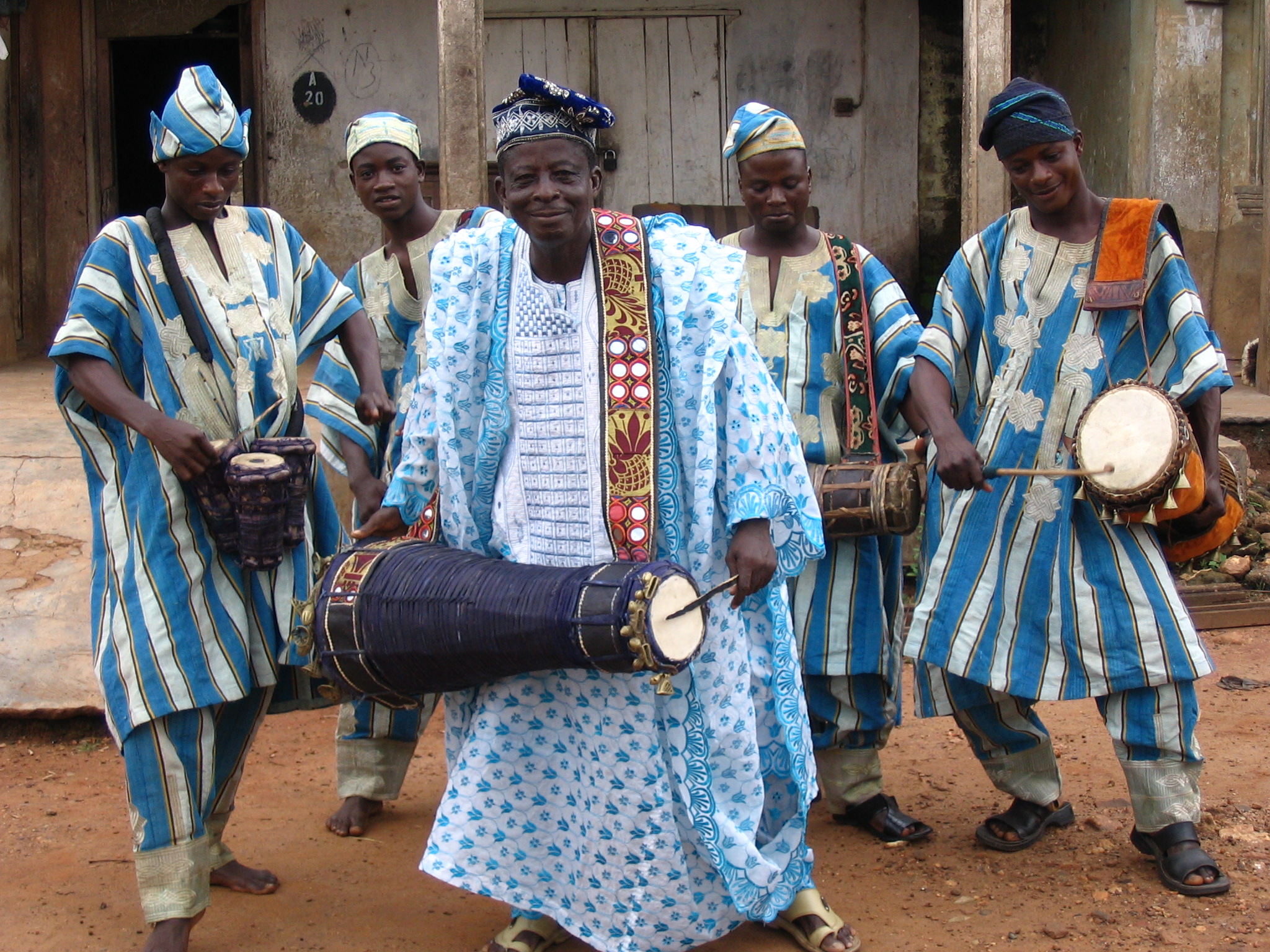
Perhaps one of the most extraordinary cultural expressions arising from the tonal nature of Yoruba is the talking drum.
Known widely as the Gángan, the Yoruba talking drum represents a remarkable meeting point between language, music, technology and oral communication.
Unlike percussion instruments used primarily to establish rhythm, the talking drum can reproduce important tonal and rhythmic features of spoken Yoruba.
The drummer manipulates the tension cords attached to the drum while striking its surface, changing the tension of the drumhead and consequently altering its pitch.
Through this technique, an experienced drummer can reproduce tonal patterns associated with spoken expressions, names and praise poetry.
The relationship between the drum and the language is therefore much deeper than entertainment.
Historically, talking drummers have played important roles in Yoruba political, religious and social life. They have accompanied traditional rulers, celebrated important personalities, preserved genealogies, performed Oríkì and participated in communal ceremonies.
The drum has also served as a means of public communication and cultural expression.
Through the skill of the drummer, words can be transformed into musical performances without losing their linguistic significance.
The Gángan demonstrates that Yoruba civilisation developed sophisticated forms of communication in which language and music were not treated as entirely separate activities.
It is a living expression of the intellectual and artistic possibilities contained within Èdè Yorùbá.
Preserving the Language Is Preserving the People
The Yoruba language represents a cultural inheritance that cannot be adequately measured by the number of people who speak it.
It preserves moral principles, family histories, traditional knowledge, spiritual beliefs, artistic expressions and collective memories.
Its proverbs communicate generations of wisdom. Its greetings demonstrate social consciousness. Its names preserve ancestry. Its Oríkì keeps historical identities alive, while its tonal structure has inspired musical traditions that remain recognisable across the world.
The survival of a language is therefore closely connected to the survival of the cultural knowledge it carries.
When a generation loses the ability to communicate fluently in its ancestral language, it risks losing access to important dimensions of its history and worldview.
This does not mean that learning other languages or participating in global cultures is undesirable. Rather, cultural advancement should not require the abandonment of one’s linguistic inheritance.
The Yoruba language deserves to remain a language of the home, the classroom, intellectual discussion, literature, journalism, entertainment, technology and public life.
Parents have a responsibility to introduce their children to it. Educational institutions should encourage its proper learning. Cultural organisations must support its preservation, while writers, musicians, filmmakers and scholars should continue to demonstrate its relevance in contemporary society.
A language survives not merely because people celebrate it during cultural festivals, but because they use it, teach it, write it, develop it and transmit it to their children.
Èdè Yorùbá is a language of history, philosophy, beauty and intellectual expression. Its resilience is a testament to the people who have preserved it across generations and geographical boundaries.
It is the language through which ancestors continue to speak, the language through which communities recognise themselves and the language through which future generations can discover the depth of their inheritance.
To preserve Èdè Yorùbá is to preserve an essential part of what it means to be Yoruba.
Lies never last. History never dies, and the TRUTH is always constant.