
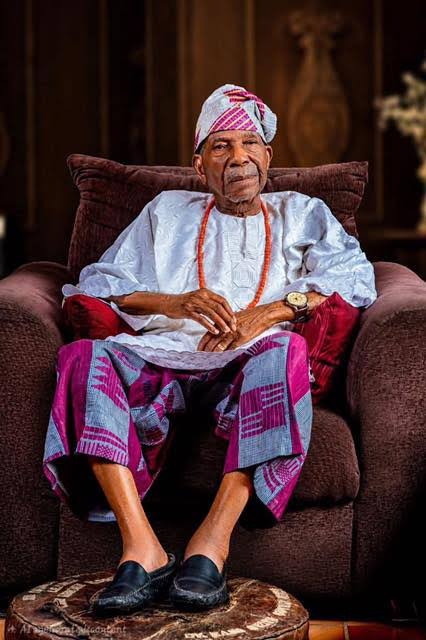
A Personal Tribute by Ademola Adekusibe
There are deaths that make the news, deaths that bring a community to tears, and deaths that force an entire people to confront the uncomfortable reality that a part of their history is slipping away. The passing of Baba Reuben Famuyide Fasoranti belongs to the last category. For the Yorùbá people, his departure at the age of 100 is not simply the loss of an elder who lived to see a century. It is the loss of a political patriarch, a custodian of an ideological inheritance, a witness to defining chapters of Yorùbá political history, and one of the men whose lives connected the present generation to a tradition built on sacrifice, discipline, education, political conviction and service. For me, this loss is also personal. Baba Reuben Fasoranti was one of the elders I looked up to, a man whose place in Yorùbá public life commanded my respect and whose passing leaves me reflecting not only on the life he lived but on the kind of people we are losing and the responsibility that now rests on those of us who remain.
I find it difficult to discuss Baba Reuben Fasoranti’s death without thinking about the generation to which he belonged. These were men who came of age when education was understood as a means of building a people, when political organisation demanded more than social-media declarations, and when commitment to an ideal could require years of personal sacrifice. Their political world was shaped by struggles over self-government, regional development, the place of the Yorùbá in Nigeria, and the enduring question of how a people should organise their political future. They were not without their disagreements, limitations or political disappointments. No honest tribute should pretend otherwise. But many of them possessed something that has become increasingly difficult to find in public life: a sense that political commitment ought to outlive personal ambition. Baba Reuben Fasoranti’s life and public service placed him firmly within that historical tradition.
Born in 1926, Baba Reuben Fasoranti lived through a century of profound change in Yorùbá society and Nigeria. He witnessed the final years of colonial rule, independence, the rise and fall of political republics, military interventions, the restoration of civilian government and the continuing struggle to build a country capable of managing its extraordinary diversity. He was not merely a spectator to these developments. His work as an educationist, his service in government and his place in the Afenifere tradition made him part of the story itself. To understand the significance of his passing, we must understand that he belonged to a generation whose experiences cannot simply be reproduced by reading history books. When men like Baba Reuben Fasoranti leave us, we lose living witnesses to the convictions, calculations, sacrifices and disappointments that shaped the political inheritance we have received.
Baba Reuben Fasoranti’s commitment to education deserves particular recognition. Before public office and the weight of political leadership became central to his public identity, he was an educationist. His involvement in establishing educational institutions, including Omolere Nursery and Primary School and Akure High School, reflected an understanding of development that remains relevant today: a people cannot secure a meaningful future without investing in the minds of their children. Education was not merely a route to individual advancement. It was a foundation for collective progress, social mobility and the development of a society capable of producing its own thinkers, administrators and leaders. This is an important part of his legacy because it reminds us that service to the Yorùbá people cannot be measured only by political statements, party affiliations or public demonstrations. It must also be measured by what a person helps build, what opportunities are created for the next generation and what remains useful long after the builder has departed.
His participation in government further established his place in the political history of the old Ondo State. Under the administration of Chief Michael Adekunle Ajasin between 1979 and 1983, Baba Reuben Fasoranti served as Commissioner for Finance. That period belonged to the political tradition associated with Chief Obafemi Awolowo and the Action Group and Unity Party of Nigeria: a tradition that placed considerable emphasis on education, public welfare, planning and the use of government as an instrument of social transformation. To recognise Baba Reuben Fasoranti’s place in that tradition is not to suggest that every policy was perfect or that the era should be exempt from scrutiny. It is to acknowledge the ideological environment in which he served and the development philosophy that shaped much of the political generation to which he belonged. His life reminds us that the Yorùbá political inheritance is not simply a collection of famous names. It is also a body of ideas about education, governance, regional development, political organisation and the responsibility of leadership.
For many people, Baba Reuben Fasoranti’s name will forever be associated with Afenifere, the socio-political organisation that became an important expression of the progressive Yorùbá political tradition. His emergence as its leader placed him in a position that demanded patience, ideological conviction and the ability to carry an inheritance larger than any individual. Afenifere was never merely a platform for issuing statements. At its historical core lay the question of how the Yorùbá people could defend their political interests, preserve their collective identity and contribute to Nigeria without surrendering their right to think and organise as a people. Its history contains disagreements and competing interpretations, as the history of every enduring political movement does. Yet its importance cannot be understood without acknowledging the generations who sustained its ideals through periods of political uncertainty and national upheaval. Baba Reuben Fasoranti was one of the men who carried that responsibility into an age increasingly distant from the circumstances in which the tradition was formed.
His role became particularly significant during the struggle for democracy and the resistance to military dictatorship. The political history of Nigeria cannot be told honestly without remembering the years when the right to determine who governed the country was violently constrained, when opposition carried real risks and when the democratic aspirations of Nigerians repeatedly collided with military power. Within the broader progressive tradition, the defence of democracy was not an abstract argument about constitutional arrangements. It concerned the right of citizens to hold leaders accountable, the right of political communities to organise and the need to prevent the state from becoming the private possession of those who controlled its instruments of coercion. Baba Reuben Fasoranti’s place in this tradition contributed to the stature he acquired among those who valued the democratic struggle and the continuity of progressive political thought.
What makes the death of a man like Baba Reuben Fasoranti particularly painful is the knowledge that we cannot replace the years he accumulated. We can appoint another leader. We can establish another committee, organise another gathering and issue another statement. But we cannot manufacture a century of lived experience. We cannot recreate the historical circumstances through which he passed, nor can we summon another individual who witnessed those events from his particular position in Yorùbá political life. The younger generation can study the history, interview surviving witnesses and preserve the documents. We can debate the ideas and determine which lessons remain relevant. But the physical presence of the man who carried that history is gone. That is the part of this loss that cannot be repaired by an announcement of succession or a ceremony of remembrance.
It is for this reason that I regard his passing as the departure of a generation, not simply the death of a prominent individual. Across Yorùbáland, many of the elders who shaped the political and intellectual environment inherited by the present generation are gradually leaving the stage. Each departure makes the question of succession more urgent. Who will preserve the institutional memory? Who will explain the principles behind the old political traditions rather than merely repeat their slogans? Who will teach younger people that identity without knowledge is easily manipulated, that political loyalty without independent thought can become servitude, and that the defence of a people’s interests requires more than emotional declarations? These are questions Baba Reuben Fasoranti’s death leaves before us, and they deserve answers more substantial than ceremonial tributes.
I remember watching one of Baba Reuben Fasoranti’s videos in which he spoke about the Yorùbá people, our collective future and the responsibility of the younger generation. One statement from that address stands out: “You are not tomorrow’s leaders; you are today’s stakeholders.” Those words carry a weight that is difficult to ignore now that Baba has departed. He was speaking to a generation that must no longer regard the future of Yorùbáland as a responsibility to be postponed until the elders are gone. He was reminding us that the future is already upon us, that the decisions we make today will determine the inheritance of those who come after us, and that we cannot continue to celebrate the achievements of previous generations while neglecting the work required to sustain them.
What makes those words particularly significant to me is that Baba was not simply asking young Yorùbá people to wait for their turn in leadership. He was challenging us to recognise that we already have a stake in the direction of our people. We cannot afford to be spectators in the affairs of our own land, leaving questions of political direction, cultural preservation, economic development and collective security entirely in the hands of others. We must acquire the knowledge to understand our history, the courage to participate in shaping our present and the discipline to build institutions that will outlive us. We must learn to disagree without destroying the bonds that hold our people together, and we must understand that love for Yorùbáland demands more than declarations of identity. It demands responsibility, work and sacrifice.
Today, with Baba Reuben Fasoranti gone, that message feels even more urgent. The elders who carried our history cannot remain with us forever. Their departure means that the responsibility they repeatedly placed before us can no longer be treated as a distant obligation. We must now demonstrate whether we truly listened when they spoke. We must show whether we understood the principles they defended and whether we possess the resolve to carry those principles into a changing world. For me, this is one of the most painful dimensions of Baba’s passing: a man whose generation helped shape the political consciousness of the Yorùbá people has departed, leaving the rest of us to confront the question of what we intend to do with the inheritance we have received.
I may have watched that video as a younger person listening to an elder speak about the future. I now reflect on those words with the grief of someone who has lost an elder he looked up to and with the awareness that time does not wait for a people to become ready. Baba Reuben Fasoranti has gone, but the responsibility he placed before the younger generation remains. We must not allow his words to become another memorable quotation repeated at ceremonies and forgotten when the ceremonies end. We must turn them into a charge to ourselves: to take our place in the affairs of Yorùbáland, to preserve what is worth preserving, to correct what must be corrected and to build a future worthy of the sacrifices of those who came before us.
I write this not as someone who claims to have occupied Baba’s inner circle, but as someone who looked up to him and recognised the significance of his place in Yorùbá public life. There are people whose stature shapes the way younger people imagine public service, even when the relationship is one of admiration from a distance. Their lives establish standards against which we measure our own ambitions and the conduct of those who seek to lead us. Baba Reuben Fasoranti was one of those figures for me. His passing has forced me to reflect on the fragility of the generation we have long regarded as a permanent feature of our collective life. We sometimes speak of our elders as though their presence is guaranteed, as though there will always be time to learn from them, to ask questions, to understand their choices and to hear their account of the past. Then comes a day when the opportunity disappears, and we are reminded that history does not wait for us to become ready.
There is grief in that realisation, but there is also a responsibility. To look up to an elder must mean more than praising him after his death. It must mean taking seriously the values, lessons and obligations that made his life worthy of attention. It must mean examining the institutions he helped sustain, understanding the ideas he represented and asking how those ideas can be made relevant to the problems of our own time. If we celebrate Baba Reuben Fasoranti’s commitment to education, we must ask whether our society is giving its children the intellectual foundation they need. If we honour his place in the progressive political tradition, we must ask whether contemporary politics is producing leaders with a comparable commitment to public responsibility. If we recognise his role in Afenifere, we must ask whether the organisations that inherit that tradition are preserving its substance or merely holding on to its name. The answers will not always be comfortable, but genuine remembrance cannot be separated from honest examination.
For the Yorùbá people across the world, the loss is deeply felt because Baba Reuben Fasoranti’s significance was never confined to one town, one state or one generation of political associates. His name became part of the wider story of a people whose identity extends across geographical boundaries but remains connected by language, history, cultural memory and a continuing debate about collective destiny. Yorùbá people living in Nigeria and across the diaspora may have different political opinions, religious beliefs and interpretations of the future, but the passing of a centenarian patriarch of Baba Reuben Fasoranti’s stature invites a common reflection: what are we doing with the inheritance left to us? A people cannot depend indefinitely on the sacrifices of generations that are disappearing. Every generation must decide what it will preserve, what it will reform and what it will contribute to those who come after it.
This is also why his departure matters to the Karọọjire tradition and the broader idea of Yorùbá self-consciousness. The strength of a people is not measured by how loudly they proclaim their greatness, but by how seriously they preserve their history, develop their institutions and prepare their successors. The elders who devoted their lives to public service cannot remain with us forever. What must remain are the records of their work, the lessons of their struggles, the institutions they built and the principles that deserve to survive them. If the passing of Baba Reuben Fasoranti produces only an outpouring of grief followed by a return to business as usual, then we will have mourned the man without understanding the magnitude of his departure. The more fitting response is to ensure that his life becomes a subject of serious study and that the younger generation understands the political and cultural inheritance for which he stood.
Yet, beyond the historical arguments and the political significance of his life, there is a simple human truth: a man who lived for a hundred years has completed a remarkable journey, but those who respected him are still entitled to mourn. Celebrating a life well spent does not cancel grief. Recognising that an elder has reached an extraordinary age does not make his departure insignificant. We can be grateful for the years Baba Reuben Fasoranti was given, proud of the service he rendered and conscious of the legacy he leaves behind, while still wishing that he could have remained with us a little longer. For those of us who looked up to him, there is a particular sadness in knowing that one more voice from that historic generation has fallen silent.
Baba Reuben Fasoranti paid his dues to the Yorùbá nation. His life encompassed education, public service, political conviction and decades of association with a tradition that has helped shape the place of the Yorùbá in Nigeria’s political history. He did not live merely to occupy space in his generation. He participated in the affairs of his people and left behind a record that deserves to be examined, documented and debated. No single individual can embody an entire nation, and no legacy should be beyond scrutiny. But some people become important reference points in a people’s story because their lives intersect with defining struggles and because they remain present long enough to connect generations that might otherwise become separated from their past. Baba Reuben Fasoranti was such a man.
Today, I mourn Baba Reuben Fasoranti as an elder I looked up to, celebrate him as a man who lived a long life of service, and recognise his passing as a profound loss to the Yorùbá people across the world. I mourn the man, but I also mourn the distance his departure creates between the present and a generation whose memories and experiences helped shape the world we now inhabit. Baba’s life should remind us that the work of building a people is never completed by one generation. Those who came before us made their contributions under the conditions of their time. We must now determine whether we have the discipline, the knowledge and the conviction to make our own.
May the Yorùbá nation find the wisdom to honour Baba Reuben Fasoranti’s memory beyond words. May the institutions and traditions he helped sustain preserve the lessons of his generation. And may those of us who looked up to him understand that admiration carries an obligation: to learn, to remember and to continue the work of building a people conscious of their history and responsible for their future.
Baba Reuben Fasoranti has departed, but the history he helped make must not depart with him. A generation is leaving us, and we cannot ask it to remain forever. We can only ensure that what it stood for is not buried with it.
Sun re o, Baba Reuben Famuyide Fasoranti. You have paid your dues. You have witnessed a century and left your mark on the history of your people. May you rest well. The Yorùbá nation mourns you, and those of us who looked up to you will remember you.