
The City That Built the Yoruba World Is Erasing Its Own Earth
By Oladipupo Ahmed
If Ibadan represents the geopolitical power and commercial ambition of nineteenth- and twentieth-century Yorubaland, Ilé-Ifẹ̀ is its direct ancestral source code.
To walk the inner ring of Ife is to step into the spatial origin story of an entire civilization. Here, myth and physical geography collapse into a single urban grid. The ancient Gbónmì structural axis—anchoring the Ọọni’s Palace (Ààfin), the sacred Enuwa square, and the central market—established a concentric pattern of royal authority and communal living that was replicated across every major Yoruba kingdom from Ketu to Benin.
Yet, as Ilé-Ifẹ̀ expands under the relentless pressure of Osun State’s modern commercial growth, a silent spatial tragedy is underway. The spiritual heart of the Yoruba world is losing its physical heritage at an unprecedented rate. Ancient earth walls (Giri Ifẹ) are being leveled for concrete block fabricators; sacred groves are squeezed by unguided residential sprawl; and the extraordinary spatial legacy that inspired the world’s most dramatic tropical modernist campus is quietly being paved over.
The urgent question facing Ile-Ife today goes to the core of regional identity: When the spiritual capital of an entire culture trades its ancient rammed-earth heritage for unguided cinder-block urbanism, what remains of its sacred spatial soul?
Terracotta, Bronze, and the Loss of the Indigenous Earth Master Plan
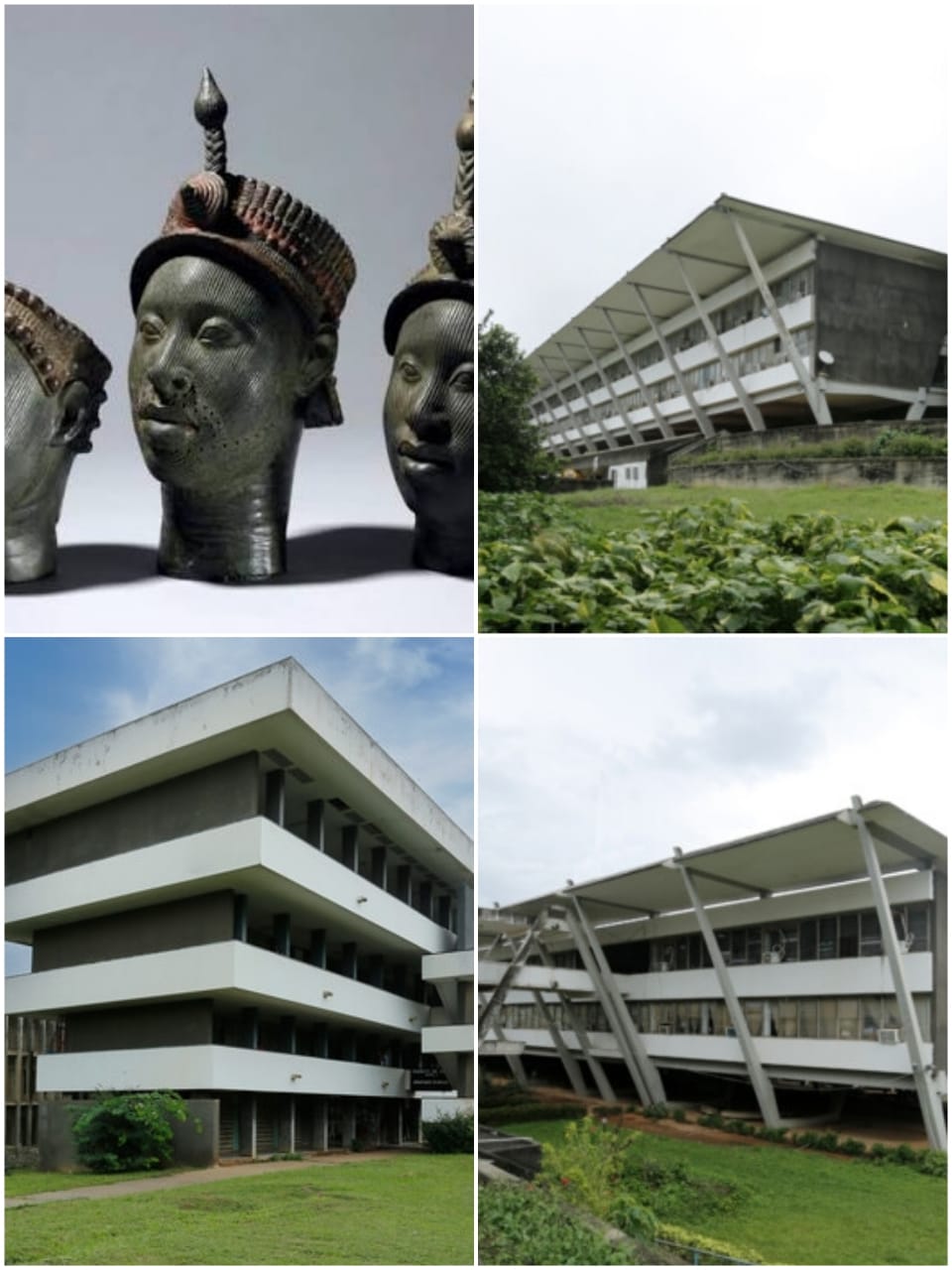
Long before European contact, Ifẹ was a sophisticated metallurgical and urban engineering center. The world-famous 12th- to 15th-century Ife terracottas and naturalistic brass heads—masterpieces that shattered early European assumptions about African art—were not isolated museum objects. They were integral elements of a deeply structured urban landscape.
The ancient city was engineered around three defining architectural features:
- The Royal Palace (Ààfin): A massive complex of interconnected courtyards (Akodi), each dedicated to specific ceremonial, judicial, or administrative functions, bounded by towering rammed-earth walls.
- Potsherd and Quartzite Pavements: Long before modern asphalt, 12th-century Ife paved its sacred courtyards and walkways with intricate, herringbone-patterned potsherd and stone pavements—a unique engineering feat designed for erosion control and rainwater drainage.
- The Concentric City Walls (Giri Ifẹ): A double-ring defense system of massive earth ramparts and moats that defined the city’s boundaries and regulated trade corridors.
Today, while the bronze and terracotta heads are safely preserved in global museums and national collections, their architectural context is disappearing.
The ancient potsherd pavements, once extensive across the historic core, have been largely destroyed by modern road grading and private home construction. Meanwhile, the historic earth walls of Giri Ifẹ are quietly being mined for building sand or bulldozed to make way for speculative real estate. We are preserving the portable artifacts while systematically destroying the physical city that created them.
The Campus Designed as a Modern Sacred City: OAU
Just three miles away from the historic Ààfin lies what is arguably the most breathtaking tropical modernist ensemble on the African continent: Ọbafemi Awólọ́wọ̀ University (OAU), originally established in 1961 as the University of Ife.
If Maxwell Fry and Jane Drew taught the world how to build for heat at the University of Ibadan, Israeli architect Arieh Sharon—working alongside Nigerian master architects and engineers—took those climate principles and fused them directly with ancient Yoruba spatial philosophy.
Sharon did not impose a western grid onto Ifẹ’s rolling hills. Instead, he studied the monumental scale of ancient Ifẹ and translated it into raw, off-shutter concrete and soaring geometric masses:
- Inverted Pyramid Geometry: The iconic Humanities and Arts buildings feature dramatically stepped, inverted pyramid profiles. By making each upper floor wider than the one beneath it, the building effectively shades itself, drastically reducing direct solar radiation on exterior walls.
- Monumental Pedestrian Spine: The core academic complex is completely car-free, arranged around expansive, multi-level concrete piazzas and covered walkways that mirror the communal gathering logic of the Ààfin’s courtyards.
- Amphitheater and Odùduwà Hall: Resting at the center of the campus layout, Odùduwà Hall and its open-air theater echo the ancient Greek and Yoruba traditions of public assembly, framed by soaring concrete columns and sweeping rooflines designed to capture prevailing breezes off the surrounding hills.
OAU’s campus was a bold declaration of post-independence African intellectual and architectural sovereignty. It proved that modern concrete construction could draw directly from indigenous spatial hierarchy without sacrificing thermal comfort or aesthetic grace.
The Neglect of a Modernist Masterpiece
Yet, like Aje House in Ibadan, OAU’s architectural triumph is wrestling with systemic maintenance failure and inappropriate physical interventions.
Decades of deferred maintenance have left raw concrete facades stained by water runoff, structural sunshades broken, and original climatic features compromised. In several departments, retrofitted air conditioning units have been clumsily punched through historic concrete screen walls, destroying the pristine elevations and short-circuiting the original passive ventilation design.
Furthermore, as student populations have surged, the city around the campus has exploded into uncontrolled off-campus housing developments in areas like Asherifa and Mayfair. Generic, poorly ventilated concrete block tenements are hastily thrown up to house thousands of students, creating a stark, depressing contrast with the brilliant climate-responsive design of the main campus just a mile away.
The Commercial Dilemma: Osun’s Sacred Cap
Back in the old city, the tension between economic survival and preservation is equally sharp around the central market zones of Ẹnuwa and Ọja Ifẹ.
No trader should be expected to conduct business in flooded, insecure, or crumbling stalls. Yet, recent redevelopment proposals for Ife’s central markets lean heavily toward the same unimaginative model seen elsewhere: tearing down historic, low-density market structures and replacing them with high-walled, oven-like concrete lock-up shops.
When commercial redevelopments sever the physical and visual link between the Ààfin, the Ẹnuwa square, and the central market, they break the historic spatial continuum that has defined Ife urbanism for nearly a millennium.
Charting a Path Forward for the Ancestral City
Ilé-Ifẹ̀ cannot afford to treat its built environment as an obstacle to modern commerce. As Osun State positions itself as a major cultural and tourism hub, preserving Ifẹ’s unique spatial legacy is both a cultural obligation and an economic necessity.
To protect both its ancient earth heritage and its modernist architectural treasures, municipal authorities, traditional institutions, and university administrators must take four concrete steps:
- Establish an Integrated Historic Core Preservation Zone: The Oyo State and Osun State historic preservation frameworks must work alongside the Ààfin to designate Ẹnuwa, the palace precincts, and surviving sections of Giri Ifẹ as protected heritage zones, prohibiting unguided demolition and sand-mining.
- Institute an Architectural Conservation Board for OAU: Obafemi Awolowo University should form a dedicated heritage management unit—comprising architects, structural engineers, and historians—to oversee all building repairs, ensuring retrofits respect Arieh Sharon’s original climate-responsive designs.
- Pioneer Earth-Architecture & Hybrid Building Codes: Local planning authorities should encourage modern earth-construction techniques (such as compressed stabilized earth blocks) for new public buildings, honoring Ife’s architectural history while lowering construction costs and indoor thermal load.
- Develop Heritage-Sensitive Commercial Markets: Market redevelopments around Ẹnuwa must adopt open-air, courtyard-style market designs that incorporate natural shade structures, modern drainage, and local materials, integrating trade seamlessly with sacred geography.
Block by Block will continue to trace the physical transformations shaping our historic cities. Next week, our field reports move west toward Abeokuta, examining how Olúmọ Rock’s iconic topography and colonial-era returns are navigating the push for modern urban infrastructure.
What ancient wall, historic compound, or modernist structure in your town is currently being lost to unguided development? Leave your field notes, photographs, and insights in the comments below.
About the Author
Oladipupo Ahmed is a practicing architect, civic-technology founder, and columnist for The Yoruba Times. He serves as Director and Lead Consultant at Design Craft Construction Ltd and founder of Core Sentinel Data Dynamics. He is the Financial Secretary of the Oyo State Chapter of Think Yoruba First and writes weekly on Yoruba urban history, spatial design, and infrastructure across West Africa.