
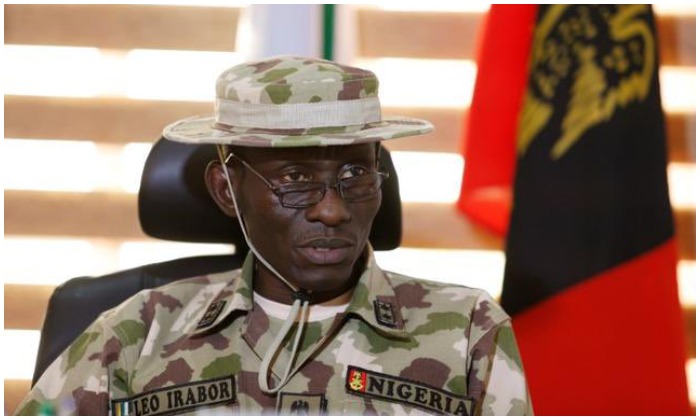
The immediate past Chief of Defence Staff, Gen. Lucky Irabor (retd.), has called for further analysis and conversations over the killings of soldiers in Delta State.
A total of 17 military personnel comprising four officers and 13 soldiers were killed by irate youths during a communal clash over a land dispute in Bomadi and Okuoma communities in the state.
The personnel attached to the 181 Amphibious Battalion were responding to a distress call when they were ambushed and killed on March 14.
Speaking during the Chief of Defence Staff Joint Task Force Commanders Conference in Abuja on Tuesday, Irabor said there was no justification for the gruesome manner in which the military personnel were killed.
He noted that to prevent a reocurrence, there must be a conversation around limiting aid to civil authority.
He said, “The recent sad occurrence in Okuama where we lost our gallant and very committed officers and soldiers requires further analysis and conversation. Their death in such a bizarre and savagery condition cannot and will never be justified.
“The perpetrators of the heinous crime must be made to face the full wrath of the law. To forestall future occurrences, therefore, there must be further conversation on the limits of aid to civil authority.”
Irabor said the military must avoid the “see-finish” syndrome while embarking on non-kinetic operations.
He noted that it portended danger for the nation should the integrity of the military be impugned.
“As we encourage non-kinetic operations and community engagements, are there limits? Is it an omnibus mandate? Should the military be first responders in situations such as the Okuama/Okoloba crisis? Are there red lines? The AFN must curtail the apparent descent to ‘see finish syndrome’.
“The integrity of the AFN, if at any time is impugned, will mean ominous signs for the nation. I therefore counsel that we remain on the path of professional excellence. This conference should examine the viable options in this regard”, Irabor said.
The Chief of Defence Staff, Gen. Christopher Musa, stated that the insecurity in the country was changing, adding that it could not be addressed in isolation.
He said, “The insecurity in our country is mutating, resilient, and cannot be treated in isolation of the prevailing challenges in the global security environment.
“While pursuing our national security objectives, we must remain wary of the fluid nature of our security environment.”
Musa said there was need for intelligence sharing and other elements of national power to overcome the insecurity confronting the nation.
He said, “The notable threats, ranging from insurgency, terrorism, separatism, kidnapping, economic sabotage, cybercrime, transnational crimes, and communal conflicts, have continued to dig deep into our national security fabrics.
“These challenges demand a comprehensive approach, one that encompasses not only military action but also other elements of national power. To effectively address these threats, we must emphasise the importance of intelligence sharing and collaboration within and across our joint task forces.”
Also speaking, Minister of Interior, Olubunmi Tunji-Ojo, urged the security agencies to build strong relationships with residents of border communities to adequately protect the country’s borders.
He also called for their inclusion of the nation’s security architecture.
Tunji-Ojo said, “You can only protect people to the extent to which they want to be protected. You need the support of the people, and if the support isn’t there, there is a limit to which you can do.
“There must be Synergy with border communities, and they must be incorporated into our security architecture. “