
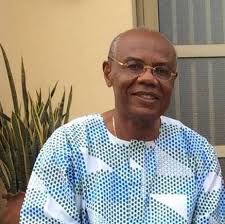
Alex Ogedengbe, a former group executive director of the Nigerian National Petroleum Corporation (NNPC) has asserted that Nigerian refineries faced a decline due to the non-release of allocated funds for maintenance and operations.
Speaking on Channel TV’s Sunrise Daily, Ogedengbe, an engineer and former managing director of Kaduna and Port Harcourt refineries, explained that even when funds were eventually released, they were often insufficient and tardy for conducting necessary maintenance.
He emphasized that the three refineries—Warri, Kaduna, and Port Harcourt—were constructed in compliance with international standards and demonstrated satisfactory performance upon completion
“They ran according to the design for many years. However, being government-owned facilities, not private ones, they were not run commercially. That’s money did not come on time for maintenance. Not enough actually was given for the maintenance project,” he said.
“So, they were just declining slowly because of lack of maintenance until they crashed – all of them crashed by 2018,” Ogedengbe added.
When one of the programme anchors asked him if he meant that monies were budgeted for maintenance of the refineries, but were not released in all cases, he responded: “Correct! You just summarised it for me. When I was the MD of Kaduna and Port Harcourt refineries, we would budget to the (NNPC) corporate headquarters. (But) every month, we would receive between 50 and 60 per cent of our budget. We were supposed to make up the rest somehow.”
Asked who should be held responsible for the non-release of the budgeted maintenance funds, Ogedengbe replied, “Corporate headquarters of the NNPC. (This is) because all the refineries were subsidiaries of the NNPC corporate and the corporate headquarters release monies there.”
The Nigerian government has recently recommenced the rehabilitation of the three refineries.
While the Minister of State for Petroleum, Heineken Lokpobiri, has expressed optimism about the Port Harcourt Refinery being operational by the end of 2023, Alex Ogedengbe criticized the rehabilitation efforts.
Ogedengbe argued that the government should have opted to construct a new refinery with advanced technology, instead of rehabilitating the Port Harcourt Refinery.
“Why is this old refinery being rehabilitated instead of building a new one? The Port Harcourt Refinery being rehabilitated by the federal government is an old refinery built in 1965 with different old technology,” he said.
Ogedengbe also expressed doubt that the Port Harcourt Refinery would be ready by the end of the year.
“If what I heard from that short, nine-minute release by the MD of the refinery is anything to go by, at best they will have some kind of mechanical completion by the end of December.
“The old refinery that is being repaired now, cannot produce more than 25 per cent maximum of crude oil. In other words, one barrel of crude will produce a maximum of 25 per cent of petrol. Whereas, the newer Port Harcourt refinery which is next door to the old one they are repairing can produce up to 48 per cent or 50 per cent of crude oil,” he stated.
“So, overall, I don’t expect any appreciable contribution. That is even if all the systems work. I don’t have confidence in that right now from what I’ve seen”, Ogedengbe added.