
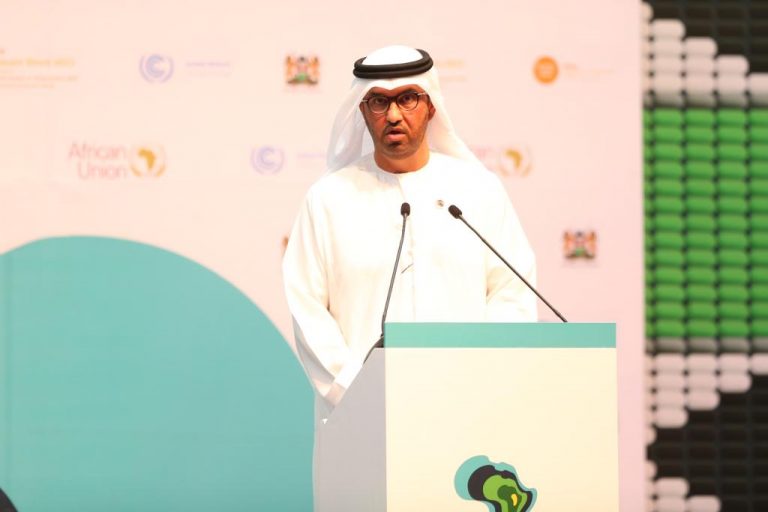
COP28 President Sultan Al Jaber delivers his remarks during the Africa Climate Summit 2023 at the Kenyatta International Convention Centre (KICC) in Nairobi on September 5, 2023.
The United Arab Emirates, on Tuesday, announced an investment of $4.5 billion in clean energy projects for Africa during a landmark climate summit hosted by Kenya, which is aimed at attracting funding to combat global warming.
“We will deploy $4.5 billion… to jumpstart a pipeline of bankable clean energy projects in this very important continent,” said Sultan Al Jaber, who heads the government-owned renewable energy firm Masdar, the UAE’s national oil company ADNOC and the COP28 climate talks.
Heads of state, government and industry leaders, are among thousands of attendees at the Nairobi summit, where Africa is promoting its potential as a clean energy powerhouse.
The Africa Climate Summit will be followed by the COP28 summit later this year in Dubai, which is expected to feature competing agendas for the world’s energy future.
“If Africa loses, we all lose,” warned Jaber, who is also the UAE’s minister for Industry and Advanced Technology.
He said the investment aimed “to develop 15 GW (gigawatts) of clean power by 2030” and “catalyse at least an additional $12.5 billion from multilateral, public and private sources”.
As of 2022, the continent’s renewable generation capacity was 56 gigawatts, according to the International Renewable Energy Agency.
The 3-day event being held in Nairobi, which began on Monday, is billed to bring together African leaders to define a shared vision for green development on the diverse continent of 1.4 billion people.
On Tuesday, the summit will offer proposals to reform global financial structures that have resulted in only a tiny fraction of investments in climate solutions being directed towards Africa.
Jaber called for a “surgical intervention of the global financial architecture that was built for a different era”, urging institutions to lower debt burdens.
Countries in Africa are hamstrung by mounting debt costs and a dearth of finance, and despite an abundance of natural resources, just three per cent of energy investments worldwide are made in the continent.
AFP