
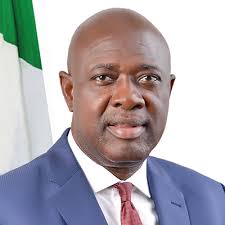
Says NNPCL should be held responsible for failure
The Minister of State for Petroleum Resources, Heineken Lokpobiri, has said that the target of the ministry is to refine two million barrels of crude per day, adding that the responsibility for the timely renovation of state-owned refineries squarely falls on the Nigerian National Petroleum Company Limited.
Lokpobiri’s remarks came as he fielded questions from State House correspondents, following the 3-day Cabinet Retreat at the State House Conference Center, Abuja.
He outlined the essential role of NNPCL in overhauling three significant refineries, a project pivotal for curtailing fuel scarcity and shifting reliance on natural gas.
Despite investing $25bn on fixing the refineries in the past 10 years, the facilities still function below 30 per cent of their potential output, a report by the 9th National Assembly shows.
The report called for a forensic audit of these efforts and recommended rehabilitating the Warri and Port Harcourt refineries while it also recommended audit of the Kaduna refinery.
Consequently, the Senate constituted an ad-hoc committee to investigate the NNPCL over the N11.35 trillion spent on the turnaround maintenance of the refineries.
The committee was meant to interrogate the Federal Ministry of Petroleum Resources, NNPCL, the Nigerian Upstream Petroleum Regulatory Commission, and the Bureau of Public Enterprises on the best approach to commercialise and ensure profitability of the state-owned refineries.
Upon being questioned about the time frame for rehabilitating the refineries, Lokpobiri clarified thus: “Yes, the rehabilitation of the refineries, if you remember, was started by the previous administration and as part of the President’s directive. I have gone around all the refineries and from what they have briefed me, Port Harcourt has three phases.
“So Phase 1 will be ready by the end of this year. I am not the one who is directly in charge of rehabilitation; it is the NNPCL and they have told me and I am holding them accountable.
“For Warri refinery, they said Phase 1 will be ready by the end of the year. Phases 2 and 3 in Port Harcourt will be ready next year, and the whole Kaduna refinery will be ready by the end of next year.
“That is what they said, and I am holding them accountable for their own words.”
The minister elaborated on his oversight approach, disclosing his practice of unscheduled site visits to monitor progress without prior announcement.
He stressed the significance of achieving a degree of rehabilitation by year-end to boost domestic refining capabilities.
Lokpobiri also touched on the influx of the Dangote refinery and the numerous modular refineries that have been issued licenses.
He pinpointed a critical bottleneck — the availability of crude as feedstock for these facilities.
Lokpobiri explained: “I believe that those refineries if we are able to achieve some level of rehabilitation by the end of this year, will also improve our domestic refining capacity. But that is not even the problem; the Dangote refinery, too, is coming.
“We have a lot of modular refineries that we have given licenses, but the challenge has been the feedstock. Even if you have the modular refinery, do you have the crude to be able to refine it?
“That’s why I said unless we produce sufficient quantity, even if the refineries are rehabilitated, there will be no feedstock. So, my challenge is to ramp up production to see how we can feed not only the big refineries but also the modular ones. These are the real employers of labour and they will do the magic,”
Lokpobiri mentioned his efforts to streamline the licensing process, cutting through red tape to ensure rapid issuance within 24 hours, provided all requirements were met.
The minister said he had taken a firm stance on issuing licences, indicating a zero-tolerance policy for inactivity.
“I have also said I don’t want to give people licenses and they use them as souvenirs; if you are given a license, you must use it within the terms or else, I will cancel it.
“Just like I didn’t know you before signing the license, I will cancel without blinking an eye,” he cautioned.
Lokpobiri added that increasing crude production was the most viable solution to the nation’s fuel crisis.
He acknowledged the inherited challenges of low production, linked to security issues and lacklustre investment.
However, the minister hinted at the potential for a “different report” in the coming months.
He declared his ministry’s ambition to nearly double crude production, setting a target of reaching close to 2 million barrels per day before the year’s end.
These efforts, Lokpobiri explained, included bolstering security and re-engaging international oil companies to reignite investment.
By tackling fiscal and regulatory concerns, Lokpobiri said he hoped to reach a production level that would substantially ease the current fuel crisis.