
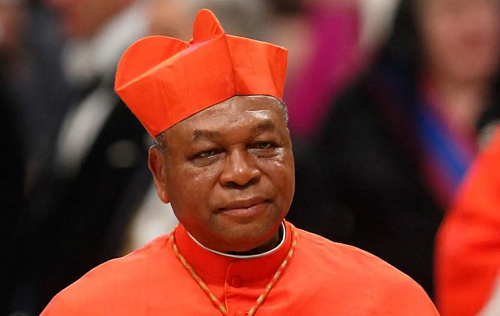
His Eminence, Cardinal John Onaiyekan, has said that it was time for Nigeria to change to a system of government that would reduce corruption and bring government closer to the people.
The Emeritus Catholic Bishop of Abuja, stated this at a policy dialogue on new governance structure for Nigeria, organised by Abuja School of Social and Political Thought (ASSPT), Abuja.
“It is time for change. One thing is definitely sure, we cannot continue the way we are going.
”If we decide to retain the system we have now, it must change from the way it is being practiced.
“If the easiest way to change is to change the system, then let’s go ahead and change the system to parliamentary, with all its advantages and disadvantages,” he added.
According to the Catholic bishop, anything that would bring government closer to the people, reduce discretion for stealing and corruption would be good for the nation.
“My understanding is that the parliamentary system is built in such a way that will not be so easy to steal humongous sums of money, and misuse of our natural resources legally.
“The problem of this nation is that government people are stealing legally, they don’t even feel that they are stealing.
“According to my own understanding, if you take more than you deserve, you have stolen”, Onaiyekan said.
He cited the provision of pension for governors, saying it was not fair after being well paid to be legally entitled to houses, cars and other things, while a retired police officer goes home with a meagre sum as pension.
Onaiyekan also said that restructuring, not constitutional amendment, would save Nigeria.
The Cardinal said that the Nigerian constitution had consistently failed to provide a clear framework for governance and religious affairs, resulting in confusion and inefficiency within the governance system.
He also advocated decentralisation of power to allow for effective governance and decision-making at the local level.
The Minority Leader of the House of Representatives, Mr Kingsley Chinda, an advocate of parliamentary system, said Nigeria needed to move from a system with so much baggage to one that provided for reward and sanctions.
Chinda is one the 60 members of the House of Representatives that introduced three bills seeking to alter the current constitution to parliamentary system of government.
“The presidential system we adopted from US is peculiar to their country, not Nigeria,” he said, adding that the parliamentary system would solve most of Nigeria’s problems.
Chinda said that the members that proposed the bill welcomed observations and contributions from Nigerians to enrich its content.
A representative of the pan-Yoruba socio-political organisation, Afenifere, Dr Akin Fapohunda, called for the provision of clearly defined process for the restructuring of the country.
“The bottomline is that we have no process. We are seeing the good, but we have not defined the process, milestones and timelines that’s what is missing.
“We agree that the house is rotten and it needs to be pulled down and we should design an alternative model, which you are now selling,” Fapounda said.
A Catholic priest, Fr George Ehusani, said integrity was key to nation building and national prosperity.
Ehusani added that “elite idiocy” would ruin any nation, no matter how perfect its structural blueprint.
The Director of ASSPT, Dr Sam Amadi, argued that the parliamentary system of government was better than the presidential system currently being practised in Nigeria.
According to him, the parliamentary system was less expensive to run, compared to presidential system, and provided better mechanisms for peer review and accountability.
“Evidence shows across the world that only few countries with Presidential system of government are doing well economically,’’ he added.
Amadi said that the school believed it was key to first discuss with critical stockholders before adoption of the parliamentary system of government in Nigeria.
He said that the discussions would be escalated to include different national institutions, religious groups and regions, so as to agree to a win-win system of government.
“We want to get more people from the North and the South and the East and the West, to come together and have them shape issues,’’ Amadi added.
NAN