
May 18, 2025
By Ayinde Adeleke
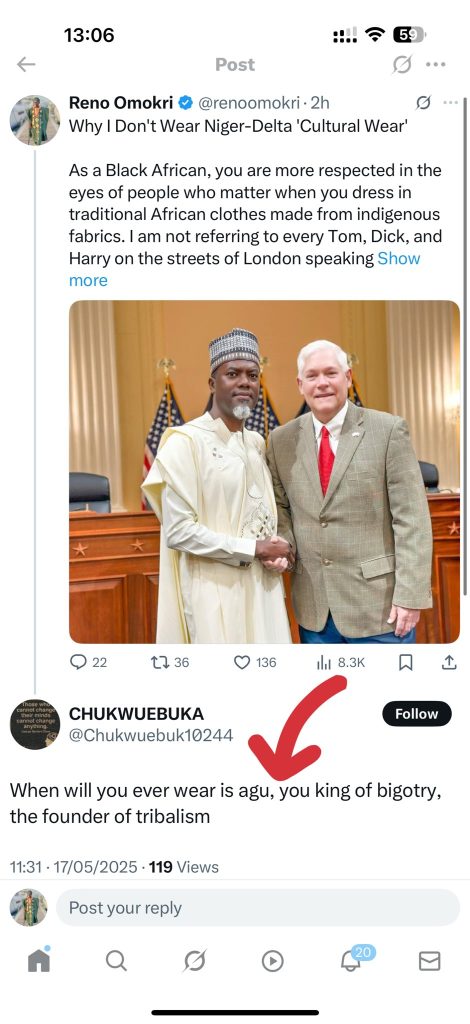
Reno Omokri has responded to criticism on social media regarding his stance on wearing Isi-Agu, a traditional attire often associated with the Igbo culture.
A user named Chukwuebuka had taken to X (formerly Twitter) to express his disapproval, calling Omokri the “king of bigotry” and “father of tribalism” for his reluctance to wear the outfit.
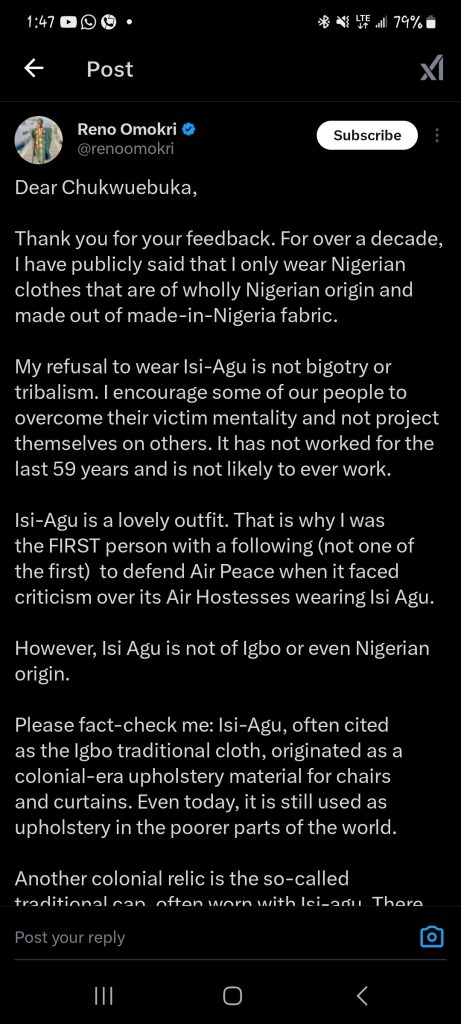
In a detailed response, Omokri clarified that his refusal to wear Isi-Agu is not rooted in bigotry or tribalism, but rather in historical accuracy.
“My refusal to wear Isi-Agu is not bigotry or tribalism,” Omokri stated.
“I encourage some of our people to overcome their victim mentality and not project themselves on others.”
Omokri went on to explain that Isi-Agu, often cited as a traditional Igbo cloth, actually has its origins in colonial-era upholstery material.
“Isi Agu is not of Igbo or even Nigerian origin,” he claimed.
“It originated as a colonial-era upholstery material for chairs and curtains. Even today, it is still used as upholstery in poorer parts of the world.”
Omokri also addressed the origins of another fabric often associated with Igbo culture, Akwete cloth.
According to him, historical evidence suggests that Akwete cloth actually originated from Ijebu, citing British historian John Gillow’s book African Textiles: Color and Creativity Across a Continent.
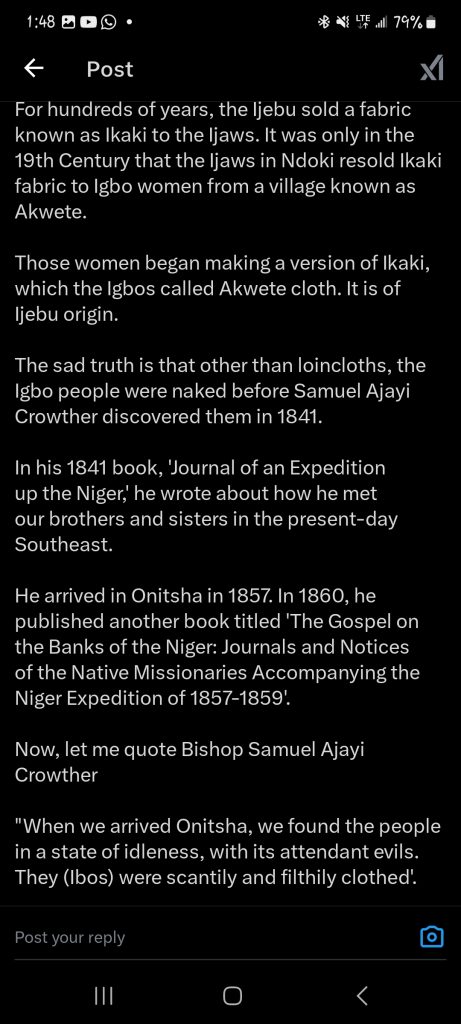
Omokri detailed how the Ijebu traded a fabric known as Ikaki with the Ijaws, who later sold it to Igbo women in Akwete, leading to the creation of what is now known as Akwete cloth.
Furthermore, Omokri emphasized that the Igbo people were largely unclothed before colonial influence.
He cited Bishop Samuel Ajayi Crowther’s journals, where Crowther described the people of Onitsha as “scantily and filthily clothed” upon his arrival in 1857.
Omokri also referenced a 1960 New York Times report on nudity in the Southeast.
Omokri challenged his critics to present an authentically Igbo cultural cloth of pre-colonial origin, made in Nigeria. “If you can show me an authentically Igbo cultural cloth of pre-colonial origin, made-in-Nigeria fabric and design, I will start wearing it tomorrow,” he said..