
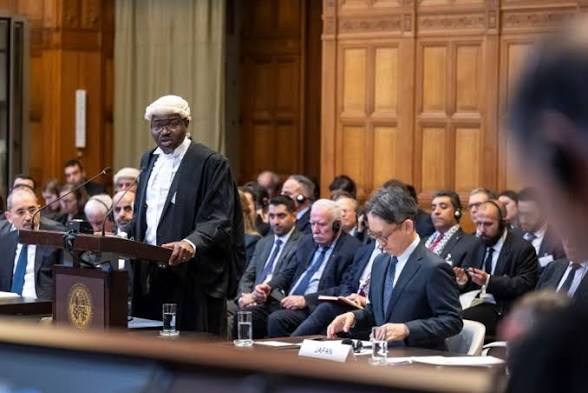
By Ademola Adekusibe
Professor Dapo Akande, a distinguished Yoruba-born legal scholar and international law expert, has been elected as a judge of the International Court of Justice (ICJ), the principal judicial organ of the United Nations.
Akande secured election on November 3, 2026, following voting by the United Nations General Assembly and Security Council, becoming the United Kingdom’s representative on the world’s highest court for the first time in nearly a decade.
He will serve a nine-year term covering 2027 to 2036, with his tenure scheduled to begin on February 6, 2027, at the Court’s headquarters in The Hague, Netherlands.
His election marks a significant milestone in an international legal career spanning nearly three decades, during which he has built a reputation as a leading scholar, legal practitioner and authority on public international law.
Akande is the Chichele Professor of Public International Law at the University of Oxford and a Fellow of All Souls College. He is also a member of the United Nations International Law Commission, a body responsible for promoting the progressive development and codification of international law.
Born and raised in Nigeria, Akande initially qualified as a lawyer in the country before pursuing an international academic and legal career in the United Kingdom. He obtained his Bachelor of Laws degree from the University of Ife in 1992 and qualified as a Barrister and Solicitor at the Nigerian Law School in 1993.
Over the years, he has advised governments and international organisations, appeared before international courts and tribunals, and contributed to major legal discussions involving human rights, international security, armed conflicts and disputes between states.
His professional experience includes work before the International Court of Justice, the International Tribunal for the Law of the Sea, the European Court of Human Rights and the African Court on Human and Peoples’ Rights.
The United Kingdom’s support for his candidacy reflected his extensive academic and practical experience in international law. His nomination also attracted support from national groups across different regions of the world.
Following his election, Akande expressed gratitude to the countries that supported his candidacy and pledged to serve independently, deciding cases through an impartial application of international law.
His emergence represents a major international achievement for a legal scholar whose professional journey began in Nigeria and has since taken him to some of the world’s most influential legal institutions.
For Nigeria and the Yoruba community, his election is another moment of international recognition for a scholar whose expertise has earned him a place among the leading figures in global legal practice.