
LAGOS — The dispute over the traditional stool of Oshodi has taken a fresh turn, with the Olushi Onigbesa Royal Family calling on the Lagos State Government to withdraw what it described as a controversial administrative directive concerning the succession to the stool.
The call was contained in an open address signed by Baba Awori, identified with the X handle @EOyigi, and addressed to Lagos State Governor Babajide Sanwo-Olu, members of the Governor’s Advisory Council, the Lagos State Council of Obas, Awori monarchs and Yoruba cultural stakeholders.
The development comes against the backdrop of an ongoing legal battle over which family is entitled to produce the Oba of Oshodi.
The Olushi Onigbesa Royal Family, through its representatives, had approached the Lagos State High Court sitting in Ikeja in Suit No. ID/1457GCMW/2026, seeking declarations concerning its claim to the traditional stool of Oshodi.
The family is also seeking orders restraining the Lagos State Government, its agencies and rival families from recognising or installing another person as the traditional ruler pending the determination of the case.
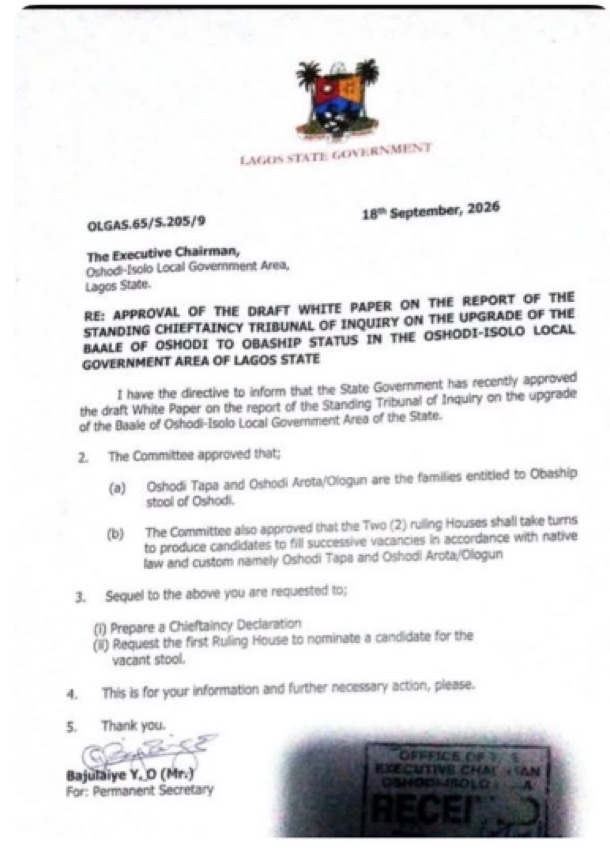
In the latest address, the family alleged that a letter dated September 18, 2026, referenced OLGAS.65/S.205/9, and an alleged draft White Paper had restricted entitlement to the Oshodi stool to the Oshodi Tapa and Oshodi Arota/Ologun families.
The family described the alleged position as an attempt to exclude the Olushi Onigbesa lineage from consideration.
The claims contained in the address have not been independently established, while the wider dispute remains before the court.
At the centre of the disagreement is the history of the Oshodi traditional institution and the interpretation of earlier land and chieftaincy proceedings.
The Olushi Onigbesa family maintains that Oshodi forms part of an ancestral Awori territory and argues that its lineage is entitled to produce the traditional ruler.
It also disputes the interpretation placed on the Supreme Court decision commonly identified as SC 53/95, arguing that the judgment concerned a land dispute and did not determine entitlement to the Obaship of Oshodi.
The opposing position of the Oshodi Tapa side is different.
The Oshodi Tapa Chieftaincy Family has challenged the Olushi Onigbesa family’s claims and relied on earlier litigation concerning land in Oshodi.
The dispute has therefore extended beyond questions of succession to include competing interpretations of land ownership, traditional authority, ancestry and customary law.
Another major point of contention is the report of the Standing Tribunal of Inquiry into Chieftaincy Matters chaired by retired Justice A.O. Silva.
The tribunal began sitting in 2005 and submitted its findings and recommendations to the Lagos State Government in 2012.
The Olushi Onigbesa family says the tribunal recommended its royal family as the family entitled to produce the Oba of Oshodi.
The family further argues that subsequent legal proceedings did not invalidate the recommendation.
According to the family’s account, the Arota Ologun faction challenged the tribunal’s recommendation before the High Court, where the case was dismissed. The family says subsequent appeals were also unsuccessful.
However, the opposing interests have disputed the interpretation and legal significance being attached to the tribunal’s recommendation.
The latest open address has consequently renewed calls for the Lagos State Government to clarify its position on the longstanding dispute.
Among the demands made by the Olushi Onigbesa family are the immediate withdrawal of the September 18 administrative letter, suspension of actions relating to the Oshodi Obaship pending the determination of the ongoing court case, and implementation of what the family describes as the ratified decision of the Justice Silva tribunal and the Lagos State Council of Obas.
The family also appealed to Yoruba monarchs, cultural leaders, entertainers, journalists and social media influencers to pay attention to the dispute.
It argued that the outcome could have wider implications for traditional institutions and questions surrounding indigenous authority in Lagos.
The family also called on Governor Babajide Sanwo-Olu and relevant state authorities to explain the status of the Justice Silva Tribunal report and the basis for any decision concerning the Oshodi stool.
However, with the matter already before the Lagos State High Court, the competing claims over ancestry, land ownership, customary authority and entitlement to the Oshodi stool remain contested.
The court proceedings provide the formal avenue for determining the legal questions raised by the parties.
For now, the Oshodi traditional stool remains at the centre of a dispute involving the Olushi Onigbesa, Oshodi Tapa and Arota/Ologun interests, with the parties presenting sharply different accounts of the history and legal status of the institution.