
October 16, 2024
By Samuel Ogunsona
A staggering 91% of children between the ages of 7-14 in Bauchi State lack reading skills, according to the United Nations Children’s Fund (UNICEF).
This alarming statistic has prompted the six Emirs in the state to take immediate action.
UNICEF’s recent data reveals that Bauchi State has 3,295 public primary schools, but only 448 Early Childhood Centers (ECD) and 784 Junior Secondary Schools.
This disparity contributes to the significant distance between schools and homes, resulting in a high pupil-classroom ratio.
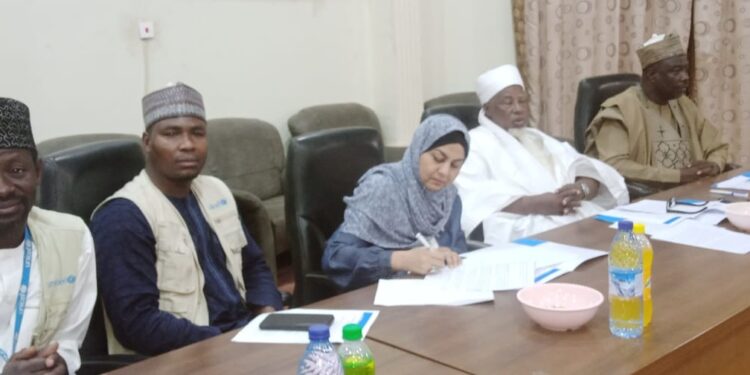
Dr. Nuzhat Rafique, UNICEF’s newly appointed Chief of Field Office in Bauchi, addressed the emirs at the Palace of Dr. Rilwanu Suleiman Adamu, emphasizing the dire need for improvement. “The learning outcomes for children at the basic education level in this country have the worst indicators, especially in the north-east,” she stressed.
According to her, “in Bauchi, the early childhood development index indicated that only 26% of children are on track, the foundational reading skills for 7-14 years stand at 9%, while the foundational numeracy for the same age category stands at 8%.
“Numerous obstacles prevent consistent learning achievement, school attendance, timely enrolment, and completion. Some of these obstacles include inadequate evidence-based policy and planning, limited budget allocation, significant shortages of qualified teachers and classrooms, poor infrastructure, poor teachers’ remuneration, cultural norms, health and safety worries, and dependence on children for income and household tasks.
“The situation calls for a concerted effort by the relevant stakeholders to address these challenges,” she advised.
While responding, the Emir of Dass, Alh. Usman Bilyaminu Othman called for proper monitoring of the state education workforce and infrastructure. The Monarch said that many teachers indulge in dereliction of duty while learners are left un untaught. “I have been personally going round in my domain to monitor schools and hospitals. I went to a school, met a few teachers while many of them were absent…I recommended SUBEB to lay them off.”
Also speaking on behalf of the six emirs, Emir of Bauchi who is also the Chairman Bauchi State Council of Emirs, Dr. Rilwanu Suleiman Adamu, commended UNICEF and the State Universal Basic Education Board for recognising the traditional institution as one the major stakeholders in community mobilisation.
The Emir expressed the commitment of the emirs to champion the enrolment, back-to-school campaign to reduce the number of out-of-school children in the state.
The Emirs’ intervention aims to tackle the root causes of this issue, ensuring that every child in Bauchi State has access to quality education and the opportunity to develop essential reading skills.