
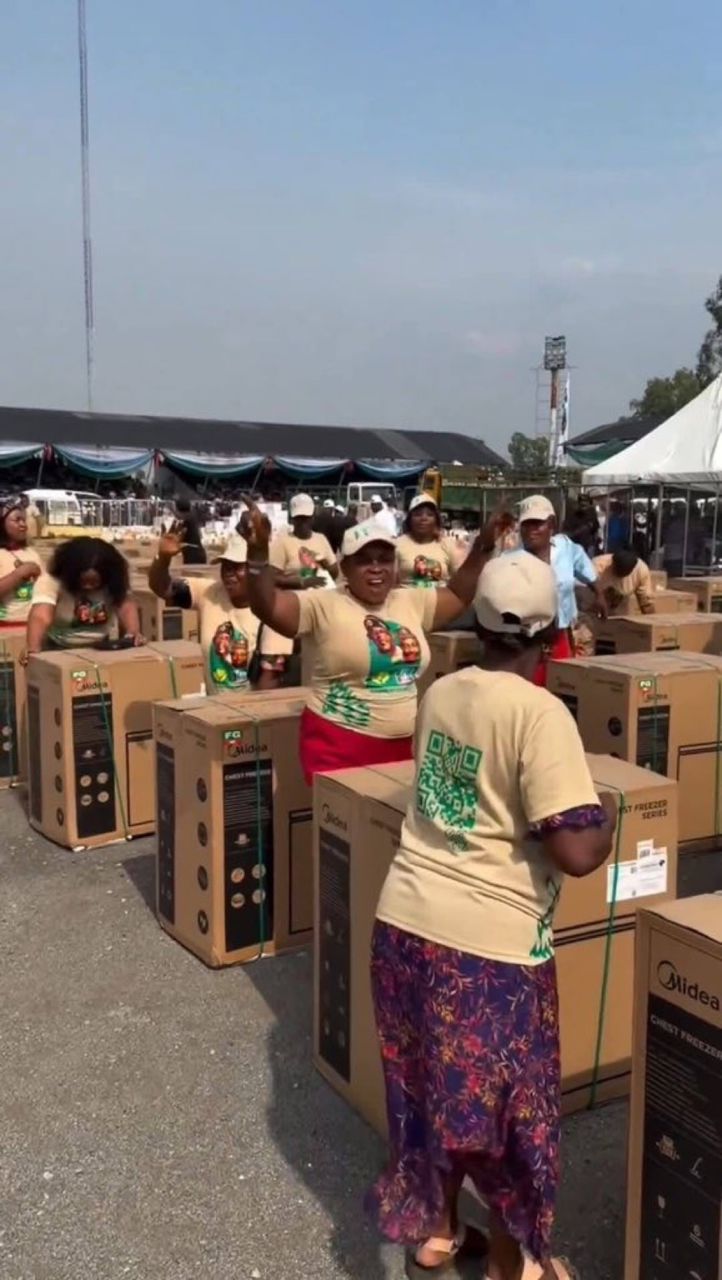
The images tell a story that no amount of spin can erase.
In Owerri, Imo State, Seyi Tinubu, son of President Bola Tinubu, was captured on camera distributing freezers to youths, practical, income-generating assets designed to put money in pockets daily, weekly, and monthly. Beneficiaries walked away with tools that can sustain families for years.
In the South West, his own father’s homeland, the people got rice.
Not freezers. Not korope. Not any asset that can generate daily income. Just rice and small foodstuffs that will be consumed in days, leaving nothing behind but empty sacks and memories.
The disparity has ignited a firestorm of outrage across Yorubaland, with many asking a simple question: why?
The Yoruba Times has reviewed multiple video evidence from both empowerment exercises. In Imo State, Seyi Tinubu is seen handing over freezers and Korope to excited beneficiaries. The items are loaded into vehicles, taken home, and immediately put to use as income-generating assets.
In the South West, the footage tells a different story. There are no freezers. No korope. No assets that can be converted into daily income. Instead, beneficiaries are seen receiving small bags of rice and food items, items that will be finished in a week, after which they return to square one.
Nowhere in the South West did we see Seyi Tinubu distributing freezers that could generate daily income for Yoruba families. Nowhere did we see korope that could serve as transport businesses. What we saw, repeatedly, was rice.
What explains this dramatic difference in treatment?
Some have pointed to Seyi Tinubu’s marital connections. His wife is Igbo. Is it unreasonable to ask whether this influences how empowerment resources are distributed?
If the South East deserves freezers assets that generate daily income why does the South West deserve only rice?
Is the calculation that Yoruba votes are guaranteed, so the region requires only minimal investment while other regions must be actively courted?
If that is the strategy, it is a dangerous miscalculation.
Across Yorubaland, the reaction has been swift and angry.
“We are watching,” one youth told The Yoruba Times. “They gave Imo freezers. They gave us rice. What are we supposed to do with rice after one week? Go back to being poor while Imo youths are building businesses with freezers?”
Another said: “This tells us exactly where we stand. We are vote banks, not investment priorities. They know we will vote for them anyway, so they give us leftovers while investing in people they need to convince.”
Social media has been flooded with comparisons. Screenshots of freezers in Imo sit alongside images of rice in the South West. The contrast is stark, and the commentary is blistering.
This is not an isolated incident. For months, observers have noted a pattern of differential treatment. While key figures in the Tinubu political family make strategic visits to the South East, engaging with leaders and rolling out visible empowerment programs, the South West receives what many describe as token gestures.
The message, whether intended or not, is unmistakable: some regions are being built up, while others are being managed.
Seyi Tinubu may have an explanation. He may have reasons. But until he provides them, the images will continue to circulate, and the questions will continue to burn.
Freezers and Korope in Imo. Small bag of Rice in Yorubaland.